Why Most “Best-Of” Lists Are Useless
I’ll be blunt: most “best pipe beveling machine” articles are written by people who have never operated one. They rank machines by brand recognition, copy specs from catalogs, and slap “Editor’s Choice” on whatever has the highest affiliate commission.
That’s not how you choose a beveling machine. That’s how you waste $5,000–$50,000.
I manufacture beveling machines. I’ve watched customers use them—correctly and incorrectly—across six continents. I’ve seen a $3,000 machine outperform a $15,000 one because it was the right tool for the job. And I’ve seen shops buy the “best” machine on some internet list, only to discover it doesn’t fit their pipe size, can’t handle their wall thickness, or won’t work in the field conditions they actually face.
The best pipe beveling machine is the one that matches your specific application. That sounds obvious. But if it were actually obvious, I wouldn’t get 20 emails a week from people who bought the wrong machine.
So here’s my version of a “best-of” list—organized not by brand or price, but by what you’re actually trying to do.
Quick Reference: Best Machine by Application
If you already know what you need, here’s the short version:
| Your Situation | Best Pick | Why |
|---|---|---|
| Small tubes under 4” | Cam-Type | 5-second setup, self-centering, under 10kg |
| Medium pipes 4”–12” (general) | ISE T-Model | ID-mount, vertical motor fits tight spaces |
| Medium pipes with thick walls | ISE II-Model | Handles walls up to 75mm |
| Medium pipes, OD access only | SOC Chuck Type | 4-jaw sync chuck, 15-second clamping |
| Large pipes 12”+ in the field | Split Frame | Clamshell design, cuts and bevels in one pass |
| Workshop production | DCM Stationary | Simultaneous cut + bevel, electric chuck |
| Field maintenance (multi-surface) | HDL Handheld | 3-in-1 capability, 7kg |
| Unlimited diameter or tanks | SKF-150L | Rides the edge, no size limit |
Want the full reasoning? Keep reading.
The Only Four Questions That Matter
Before you look at a single machine, answer these:
1. What’s your pipe diameter range?
This eliminates 70% of options immediately. A machine designed for 2” tubes is mechanically incapable of handling 24” pipe. Sounds obvious, but I’ve had customers try.
2. What’s your maximum wall thickness?
This is where most buyers get burned. A machine might claim to handle 8” pipe—but can it handle 8” Schedule 160 with 23mm walls? Usually not. Always check the wall thickness spec, not just the diameter.
3. Where are you working—workshop or field?
A 450kg stationary machine produces beautiful bevels. It also can’t go up a scaffold. If 30% of your work is on-site, you need a portable solution—or two machines.
4. What code are you welding to?
ASME B31.3, AWS D1.1, API 1104—each has different tolerance requirements for bevel angle, root face, and surface finish. If you’re doing non-code structural work, a less precise machine might be perfectly fine and save you money. If you’re doing nuclear or offshore work, precision isn’t optional.
Get these four answers straight, and the “best” machine reveals itself. Let me show you how.
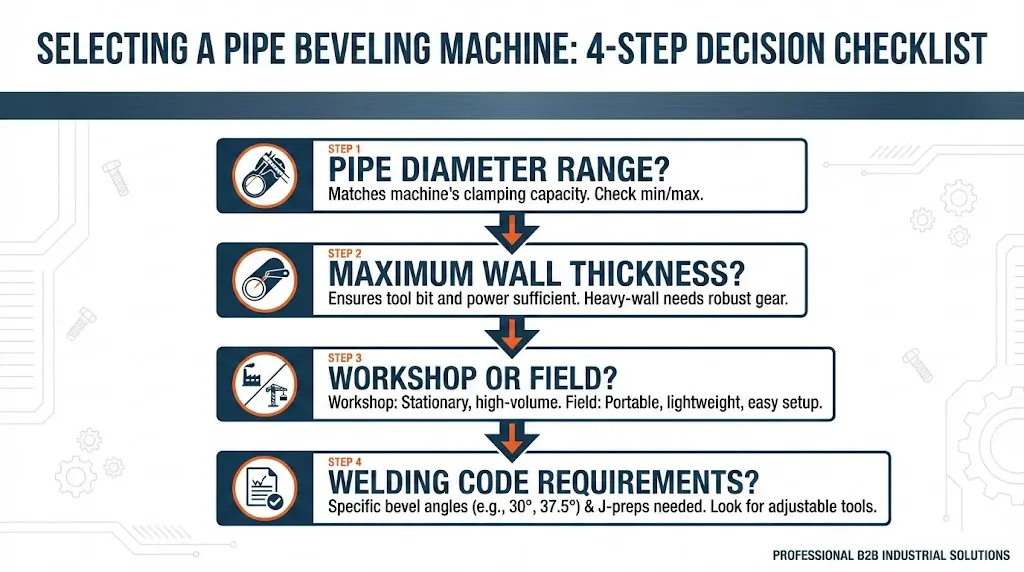 The four questions that eliminate 90% of wrong choices before you look at a single spec sheet.
Best for Small Pipes (Under 4 Inches)
Small-diameter pipe beveling is a different game. The machine has to be compact enough to clamp onto tubes that are sometimes barely wider than your thumb, and rigid enough to produce code-quality bevels. Most general-purpose machines can’t do this.
My top pick: Cam-Type Self-Centering Beveler
The Cam-Type series is what I recommend first for shops working with 14–114mm tubes. Here’s why:
- 5-10 second setup. The cam-lever clamp is one action—squeeze, lock, go. When you’re prepping 50 tube ends per shift on a heat exchanger, those seconds add up to hours.
- Self-centering. No shimming, no adjusting. The cam mechanism centers the tool automatically. This matters when your operators are tired at hour 8.
- Lightweight aluminum body. Under 10kg. Your operator can hold this overhead for tube-bank work without destroying their shoulders.
I’ve timed this directly: on a boiler tube replacement job, the Cam-Type prepped 40 tube ends in 3 hours. The previous method (hand grinding) took the same crew 2 full days. With basic weekly maintenance, these machines stay at that performance level for years.
When to choose something else
The Cam-Type’s limitation is wall thickness—it handles standard schedules well, but for thick-wall small-bore pipe (think Schedule 160 in 2” or 3”), the ISC Block Type is a better choice. Its bidirectional block clamping provides the rigidity needed to machine through heavy walls without chatter. Heavier (8–11kg), slower to set up, but it won’t stall on a 15mm wall.
For boiler tube work specifically, the Block Type is my default recommendation. Read the case study on pressure vessel nozzle work—the principles of rigidity vs. speed apply directly.
Best for Medium Pipes (4 to 12 Inches)
This is the sweet spot where most industrial pipe work lives—process piping, power plant systems, pressure vessel connections. It’s also where the most choices exist, which means the most potential to choose wrong.
My top pick: ISE T-Model (ID Mount)
For the 4”–12” range, the ISE T-Model is the machine I sell the most of, and the one that generates the fewest complaints. That correlation isn’t accidental.
- ID-mounted, self-centering. Expands inside the pipe bore and locks. No external clamps competing for space with your fit-up equipment.
- Vertical motor design. This is the detail that matters in the real world: the motor sits on top, not to the side, so the machine fits between pipe racks and in tight manifold spaces where side-mounted motors hit the adjacent pipe.
- 9 models covering 18–830mm ID. One product line for nearly your entire pipe range. That means one set of spare tooling, one training program, one maintenance procedure.
A refinery maintenance team in the Middle East switched their standard weld prep tool from angle grinders to ISE T-Models. Their bevel-to-weld cycle time dropped 62%. More importantly, their first-pass radiography acceptance went from 81% to 97%. That’s not because the T-Model makes better bevels than other machines—it’s because the T-Model is simple enough that every operator on the crew produces the same result.
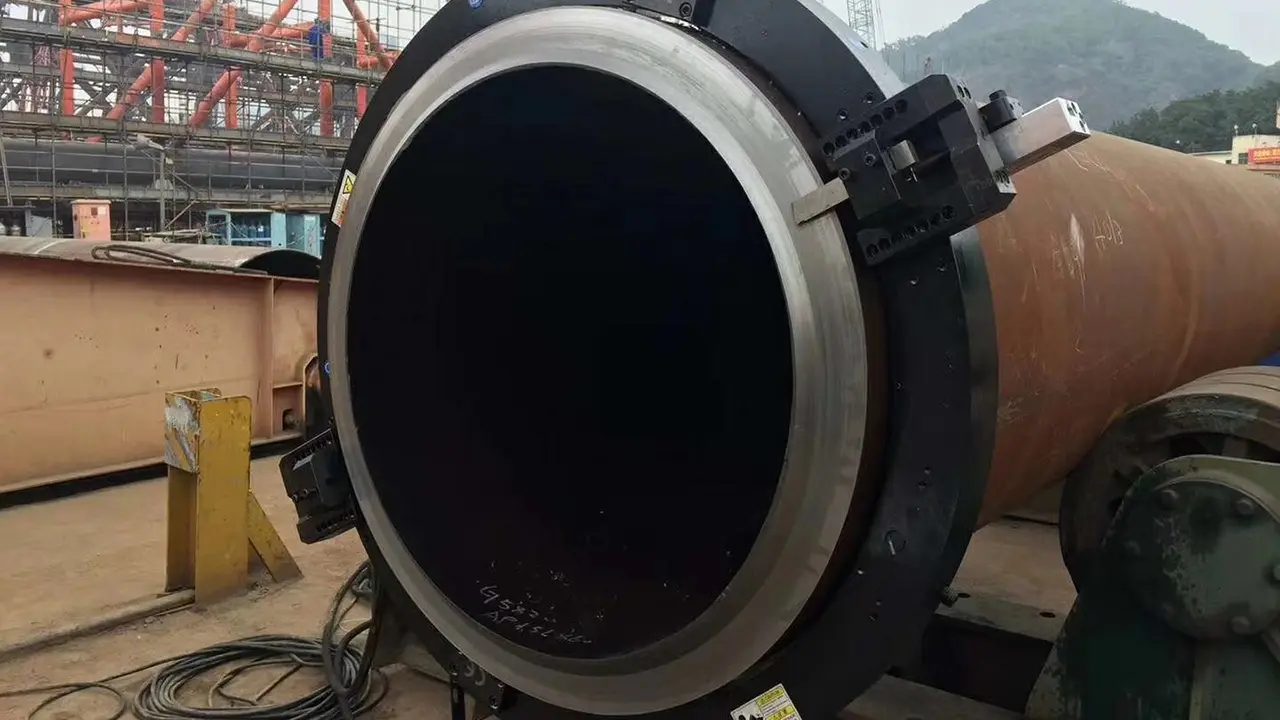 ISE T-Model locked inside a 6” carbon steel pipe. The vertical motor clears the adjacent pipe rack—the detail that makes this machine work in real plant layouts.
For heavy walls: ISE II-Model
When wall thickness exceeds 15mm—common in high-pressure steam lines and thick-wall headers—the T-Model runs out of power. The ISE II-Model picks up where it leaves off:
- Handles walls up to 75mm (yes, seventy-five millimeters)
- Angled motor design delivers more torque at the cutting edge
- Same ID-mount, self-centering principle as the T-Model
I won’t pretend the II-Model is as fast or convenient as the T-Model—it’s heavier and takes longer to set up. But when you’re beveling P91 chrome-moly at 40mm wall thickness, convenience isn’t what matters. Cutting without metallurgical damage is what matters—and that’s exactly why cold cutting beats thermal methods on alloy steels. The II-Model’s cold cutting process leaves zero heat-affected zone.
The OD-mount alternative: SOC Chuck Type
Not every pipe allows ID access. If you’re working with capped ends, partially assembled spools, or pipes with internal obstructions, the SOC Chuck Type clamps from the outside:
- 4-jaw synchronous chuck. 10x faster clamping than screw-type OD clamps. I’ve timed it: 15 seconds versus 2–3 minutes for manual screw adjustment.
- 50–610mm range with 30mm wall capacity
- Separable flap ring — the clamp stays on the pipe while you change tool bits. This saves 5–10 minutes per tool change on a typical shift.
My honest assessment: if you can mount from the ID, do it. ID-mount machines are inherently more concentric. But when you can’t, the SOC Chuck is the best OD-mount option I’ve seen in this size range.
Best for Large Pipes (12 Inches and Up)
Large-diameter pipe work is where equipment choice gets expensive—and where getting it wrong hurts the most. A bad bevel on a 36” pipeline weld can cost $5,000+ in rework.
For pipeline and field work: Split Frame
The Split Frame series is the industry standard for large-diameter in-line pipe work, and for good reason:
- Clamshell design opens and wraps around the pipe without removing it from the rack or trench
- 89–1830mm OD range with walls up to 110mm
- Simultaneous cutting and beveling in a single pass
- Four drive options: electric, pneumatic, hydraulic, or CNC—match the power source to your jobsite
I’ve watched Split Frames work on pipeline tie-ins in -30°C Canadian winters and 50°C Middle Eastern summers. They’re not delicate instruments. They’re built to survive real job sites.
23 models means you need to get the sizing right. The most common mistake I see: buying a Split Frame that’s too large for your pipe. An oversized frame wastes rigidity and creates vibration. Tell me your pipe OD range and I’ll narrow it to 2–3 models.
For unlimited diameter: SKF-150L Capless
What about pipes over 1800mm? Or storage tanks? Or curved pressure vessel shells?
The SKF-150L doesn’t clamp around the pipe—it rides along the edge. No diameter limit. No maximum size. If it has an edge, the SKF-150L can bevel it.
- Works on pipes 114mm and up with no upper limit
- Also handles flat plates 5–25mm thick
- Self-propelled along the workpiece edge
- Only 35kg—one person can carry it
This is a niche machine, and I’m transparent about that. If you have a conventional pipe diameter range, a conventional clamping machine (Split Frame or SOC Chuck) will give better results. The SKF-150L exists for the jobs where nothing else physically fits.
For fixed large-bore pipes: DMM-YG Milling
When the pipe is already installed and you can’t use a split frame—think headers in operating power plants or fixed risers on offshore platforms—the DMM-YG series travels circumferentially around the pipe end:
- Designed for pipes over 800mm
- Handles walls up to 100mm
- Auto-travel around the circumference
- Surface finish Ra 3.2–6.3μm—smooth enough for critical welds without additional grinding
Best for Field and Maintenance Work
Field conditions change everything. Your machine might work perfectly in the shop and be completely useless at the job site because it’s too heavy, needs power that’s not available, or won’t fit in the access space.
Portable picks by scenario
Tight access, small pipes (boiler rooms, between racks): → ISE T-Model with pneumatic drive. Lighter than electric, no spark risk, fits where nothing else does.
Multi-surface field work (pipes, plates, nozzle cutouts): → HDL Handheld — 3-in-1 capability at 7kg. Handles straight edges, curves, and circular openings. When you don’t know exactly what you’ll encounter on-site, this is the one to throw in the truck.
Plate edges in the field (structural steel, tank shells): → SKF-15 Handheld — 4–6kg, single-hand operation, 15°–60° adjustable angle. This is the angle grinder replacement for plate work.
In-line pipeline cutting and beveling: → Split Frame with pneumatic or hydraulic drive for hazardous environments.
The field reality check
I’ll be honest about something the brochures won’t tell you: every portable machine involves trade-offs. Lighter means less rigid. More portable means less powerful. Faster setup means fewer clamping options.
The key is knowing which trade-off matters least for your work. If you’re doing 2 bevels per day in different locations, setup speed matters more than raw cutting speed. If you’re doing 50 bevels on one site, cutting speed dominates.
Best for Workshop Production
If your pipes come to you (not the other way around), you have options that field crews don’t: electricity, floor space, and overhead cranes. Use them.
High-volume pipe spool prefab: DCM Stationary
The DCM Stationary series does what portable machines can’t: cuts and bevels simultaneously, with electric self-centering chuck clamping that eliminates setup variation.
- 50–630mm pipe range
- Simultaneous cut and bevel in one operation
- Electric chuck—press a button, walk away
- Cold cutting technology—no heat damage on any material
For pipe spool fabrication shops, this is the machine that changes the math. One operator on a DCM replaces 2–3 operators doing separate cutting and beveling operations. I’ve seen shops increase their daily spool output by 40% after installing a DCM—not because the machine is faster per cut, but because it eliminates the handling, re-clamping, and re-positioning between separate cut and bevel steps. When you run the actual ROI numbers, a stationary machine often pays for itself within 6–8 months in a busy shop.
When stationary doesn’t make sense
If your pipe sizes vary wildly day to day, or if more than 20% of your work happens on-site, a stationary machine creates a bottleneck. You’ll end up with the DCM sitting idle while your team is in the field with angle grinders. In that case, invest in portable machines and accept the per-bevel speed penalty.
The Machines I Wouldn’t Recommend
This is the section that makes my sales team nervous. But I promised honest, and honest means telling you what not to buy.
Don’t buy based on brand alone
Big brands with established distribution networks aren’t automatically better. They’re automatically more expensive—because you’re paying for their showrooms, their trade show booths, and their regional sales reps. The machine itself might be manufactured in the same Chinese factories as machines sold at half the price.
I know this because I’m one of those factories. Some of the biggest names in beveling equipment don’t manufacture anything—they source from manufacturers like us and add their logo. You can buy the same engineering directly.
Don’t buy the cheapest option
The other extreme is equally dangerous. I’ve seen shops buy the absolute cheapest machine from an unknown supplier, only to discover:
- Replacement tooling doesn’t exist (or costs more than a better machine)
- Tolerances drift after 3 months because the spindle bearings are garbage
- The “pneumatic” option is actually a cheap conversion that loses 40% power
- Service and support means “send an email to a Gmail address and hope”
The sweet spot is buying from the manufacturer directly—not the cheapest assembler, not the most expensive brand. You want the people who actually design and machine the components. If you’ve never sourced industrial equipment directly from a factory before, I wrote a practical guide on the process—MOQ, lead times, quality control, and the stuff nobody warns you about.
Don’t buy more machine than you need
This is the most common mistake. A shop doing 6” Schedule 40 carbon steel doesn’t need a machine rated for 24” Schedule 160 chrome-moly. They need a machine optimized for what they actually do, 90% of the time.
Buy for your 90% case. Rent or subcontract the 10%.
How to Choose: A Decision Framework
After everything above, here’s the simplified decision tree I use with customers:
Step 1: Pipe or plate?
- Pipe → Continue below
- Plate → See our plate beveling guide or browse plate beveling machines
- Both → You likely need two machines. The HDL Handheld is the only single machine that does both acceptably, but dedicated machines do each better.
Step 2: What’s your primary pipe size?
| Your Pipe Range | ID Mount | OD Mount |
|---|---|---|
| Under 114mm | ISE T-Model | Cam-Type or ISC Block |
| 50–610mm | ISE T-Model or ISE II-Model | SOC Chuck Type |
| Over 600mm | N/A | Split Frame or DMM-YG |
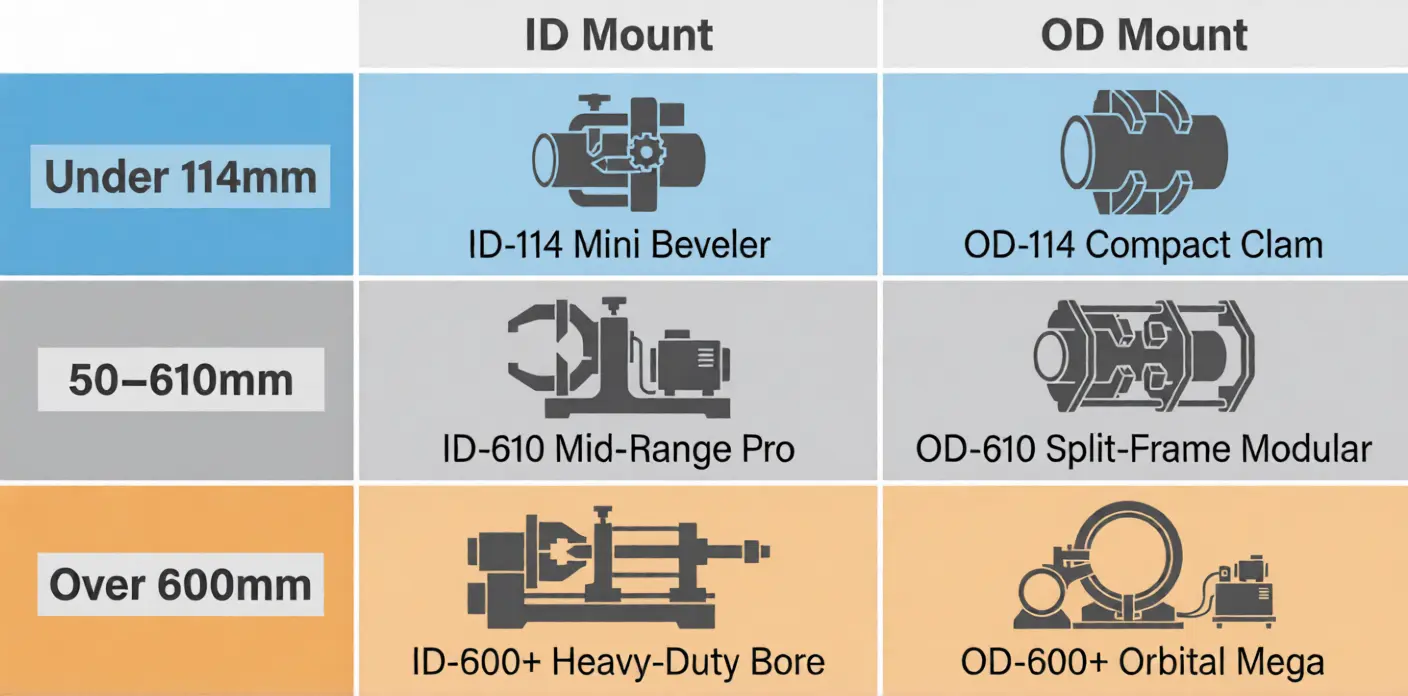 Machine selection mapped to pipe diameter and mount type. If your pipe range crosses multiple rows, pick the machine that handles your 90% case.
Step 3: Field or workshop?
- Mostly field → Prioritize weight, setup speed, and drive flexibility (pneumatic for hazardous areas)
- Mostly workshop → Consider the DCM Stationary for production work
- Mixed → Buy a portable machine that works in both environments
Step 4: Check wall thickness
This is the step people skip. Go back to whichever machine you selected and verify it handles your maximum wall thickness with margin. If your heaviest wall is 20mm, don’t buy a machine rated for 20mm—buy one rated for 30mm. You want headroom, not a machine running at its absolute limit every day.
The Bottom Line
There is no single “best pipe beveling machine.” There’s a best machine for your pipe size, your wall thickness, your working environment, and your production volume. Anyone who tells you otherwise is selling you something—probably the wrong thing.
Here’s what I can tell you from 15+ years of manufacturing these machines:
- ID-mount machines produce more concentric bevels than OD-mount. Use ID-mount when you can.
- Cold cutting is non-negotiable for alloy steels, stainless, and any code work requiring metallurgical integrity.
- Setup speed matters more than cutting speed for shops doing varied work. Cutting speed matters more for production runs.
- Buy from the manufacturer. Not the reseller, not the trading company, not the Amazon listing. The people who designed the machine and can support it.
If you’re still not sure which machine fits, send me your specs:
- Pipe material and grade
- Diameter range (ID or OD, specify which)
- Wall thickness range
- Bevel profile needed (V, J, compound—or “whatever the code requires”)
- Field, workshop, or both?
- Approximate volume (bevels per day)
I’ll give you a specific recommendation within 24 hours. And if the honest answer is “you don’t need our machine,” I’ll tell you that too.
Related reading:
- Pipe Bevel Angles & Code Requirements — The angle specs your machine needs to hit, by code
- ID Mount vs OD Mount Pipe Bevelers — The first decision in machine selection
- Pipe Bevel Types: Complete Guide — V-bevel, J-prep, compound—which profile for your joint
- Cold Cutting vs Thermal Cutting — Why your welding inspector cares about how you cut
- Portable vs Stationary Beveling Machine — Field vs. workshop decision framework
- What Does a Beveling Machine Actually Cost? — The 9 factors that drive pricing
- Beveling Machine Price Guide 2026 — Real price ranges by machine type and size
Based on production data from customer installations across six continents and our own manufacturing and testing experience. Recommendations reflect machines we manufacture—I’m transparent about that bias. But I’m also transparent about when our machines aren’t the right choice, because selling you the wrong machine costs me more in reputation than the margin is worth.