The Cut Your Inspector Sees
I’ll start with a scene I’ve watched play out dozens of times on job sites: a pipe fitter makes a beautiful oxy-fuel cut, grinds it smooth, bevels the edge, and calls for inspection. The welding inspector pulls out a hardness tester, presses it against the bevel face, and says three words that ruin the schedule: “Hardness exceeds maximum.”
Now the pipe fitter has to grind back another 2–3mm to remove the hardened layer, re-bevel, and call for re-inspection. On a 12” Schedule 80 chrome-moly pipe, that’s 45 minutes of rework per cut. On a project with 200 cuts, that’s 150 hours of unplanned labor—roughly $15,000–$18,000 at typical burdened rates.
The thermal cutting method was fast. The total process was slow. And that’s the core misunderstanding I see in every shop that hasn’t switched to cold cutting yet: they compare cutting time, when they should be comparing total time from raw pipe to weld-ready bevel.
What Heat Actually Does to Your Pipe
This isn’t theory. I’ve sent cut samples from both methods to independent metallurgical labs, and the results are consistent across dozens of tests. Here’s what thermal cutting does at the microstructural level:
Heat-Affected Zone (HAZ)
Every thermal cutting method—oxy-fuel, plasma, laser—creates a heat-affected zone adjacent to the cut face. The width and severity varies by method:
| Cutting Method | Peak Temperature at Cut | HAZ Width | Hardness Increase in HAZ |
|---|---|---|---|
| Oxy-fuel (acetylene) | 3,200–3,500°C | 3–8mm | 30–80% above base metal |
| Plasma | 20,000–30,000°C | 1–3mm | 20–50% above base metal |
| Laser | 10,000–20,000°C | 0.5–1.5mm | 15–40% above base metal |
| Cold cutting (mechanical) | < 50°C | None | None |
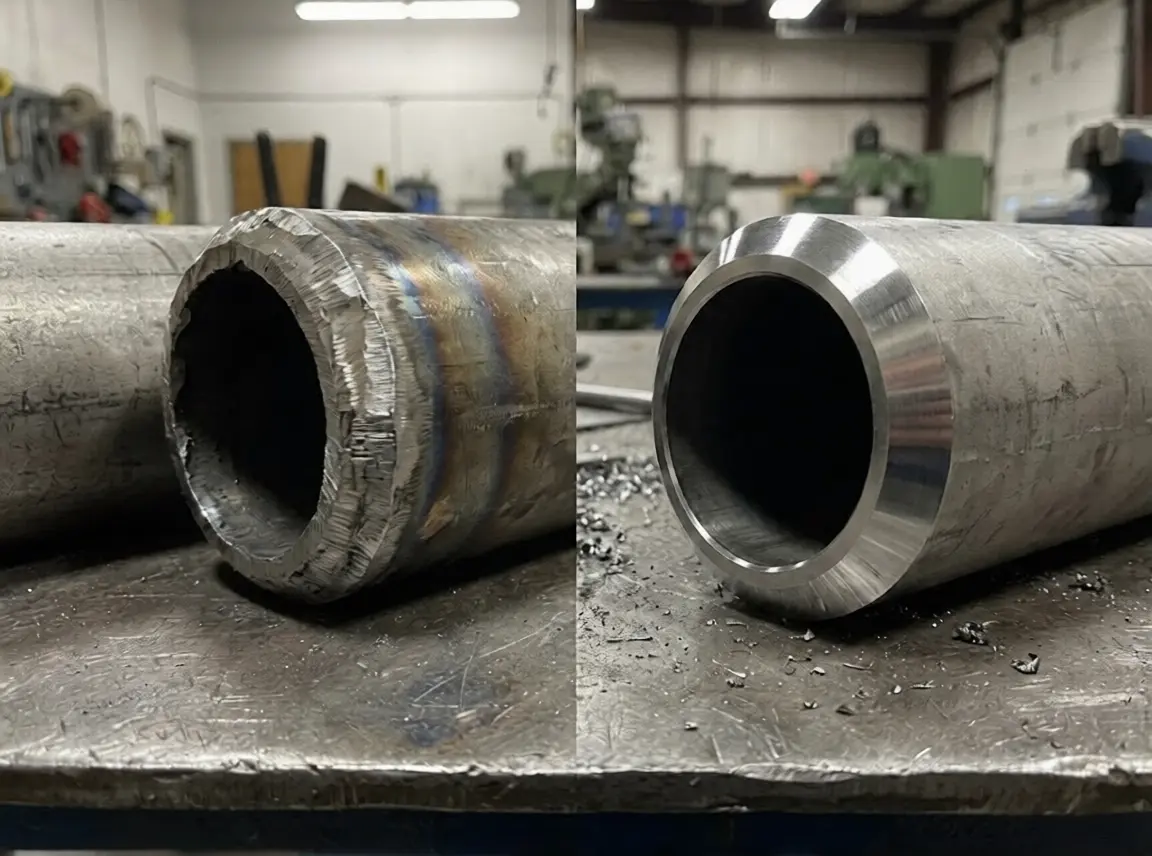
That HAZ isn’t just a discolored band. It’s a zone where the microstructure has been altered—sometimes permanently.
What happens in carbon steel
On plain carbon steel (A106, A53), the HAZ typically forms untempered martensite at the immediate cut surface. This hard, brittle layer is prone to hydrogen-induced cracking during subsequent welding. On Schedule 40 and below, the effect is minor and often ground away during bevel preparation. On heavy-wall pipe, the HAZ penetrates deep enough that normal grinding won’t remove it.
What happens in chrome-moly (P11, P22, P91)
This is where thermal cutting becomes genuinely dangerous. Chrome-moly alloys are designed to be heat-treated to a specific microstructure. When you hit them with 3,000°C from an oxy-fuel torch, you create a narrow band of extremely hard martensite that:
- Exceeds the maximum hardness limits in ASME B31.1, B31.3, and most project specifications (typically 248 HV for P22, 265 HV for P91)
- Requires PWHT before welding—not the post-weld heat treatment you planned for anyway, but an additional pre-weld treatment just to undo the cutting damage
- Creates a crack initiation site if the hardened zone isn’t fully removed or treated
I’ve tested P91 samples cut with oxy-fuel that showed 380–420 HV at the cut face—more than 50% above the 265 HV maximum. That pipe cannot be welded until the entire hardened layer is removed by machining or treated with a localized PWHT cycle. Either option adds hours to the schedule.
What happens in stainless steel (304, 316, duplex)
Stainless steel has a different problem: sensitization. When austenitic stainless is heated to 450–850°C (the “sensitization range”), chromium carbides precipitate at the grain boundaries. This depletes the chromium in the adjacent metal, destroying the corrosion resistance that’s the entire reason you’re using stainless in the first place.
The result: a pipe that passes visual and dimensional inspection but fails in service because the HAZ corrodes preferentially. I’ve seen 316L process piping in a chemical plant develop pinhole leaks within 18 months of commissioning—traced directly to oxy-fuel cut surfaces that weren’t fully removed before welding.
Cold cutting produces none of these metallurgical effects. Zero. The pipe material at the cut face is identical to the material 100mm away from the cut face.
Thermal Methods Compared
Not all thermal cutting is equal. Let me be fair to each method:
Oxy-fuel (oxy-acetylene)
How it works: A fuel gas and oxygen flame preheats the steel to its ignition temperature (~870°C for carbon steel), then a high-pressure oxygen jet burns through the material.
Strengths:
- Cheapest equipment cost ($500–$2,000 for a portable setup)
- Cuts any thickness—I’ve seen oxy-fuel cut 300mm+ steel
- No electricity required—works anywhere
- Most welders already know how to use it
Weaknesses:
- Widest HAZ of any method (3–8mm)
- Rough cut surface requires heavy grinding before beveling
- Doesn’t work on stainless steel or non-ferrous metals
- Slag, dross, and oxide contamination on cut faces
- Dimensional accuracy is operator-dependent: ±1–3mm is typical
My honest assessment: Oxy-fuel is a legitimate cutting method for non-critical carbon steel work where you have time and budget for post-cut grinding. For anything involving alloy steel, stainless, or code work with hardness requirements, it creates more problems than it solves.
Plasma
How it works: An electrically conductive gas (usually compressed air or nitrogen) is superheated to 20,000–30,000°C, creating a plasma arc that melts and blows through the material.
Strengths:
- Fast—2–5x faster than oxy-fuel on material under 25mm
- Works on stainless and non-ferrous metals
- Narrower HAZ than oxy-fuel (1–3mm)
- Better dimensional accuracy: ±0.5–1mm with CNC
Weaknesses:
- Still creates a HAZ—narrower but still metallurgically significant
- Requires electricity and compressed gas
- Cut quality degrades rapidly as consumables wear
- Dross on the bottom side of horizontal cuts
- Edge hardening on alloy steels still exceeds code limits
My honest assessment: Plasma is the better thermal method for most applications. If thermal cutting is your only option, plasma with nitrogen shielding produces the cleanest result. But “better thermal” is still thermal—the HAZ exists, and on alloy steels, it still requires removal.
Laser
How it works: A focused laser beam melts or vaporizes the material in a narrow kerf, with an assist gas blowing the molten material away.
Strengths:
- Smallest HAZ (0.5–1.5mm)
- Excellent dimensional accuracy: ±0.1–0.3mm
- Clean cut surface, minimal post-processing
- Automated, highly repeatable
Weaknesses:
- Equipment cost: $100,000–$500,000+ for industrial systems
- Limited to relatively thin material (typically under 25–30mm for steel)
- Not portable—workshop only
- Still creates a HAZ, however narrow
- Reflective materials (copper, aluminum) require specific laser types
My honest assessment: Laser cutting is the best thermal method by far. If you’re running a high-volume fabrication shop cutting material under 25mm, a fiber laser is hard to beat on speed and quality. But it’s a workshop-only, high-capital solution—and it still creates a thermal effect that matters on sensitive alloys.
Cold Cutting: What It Is and Isn’t
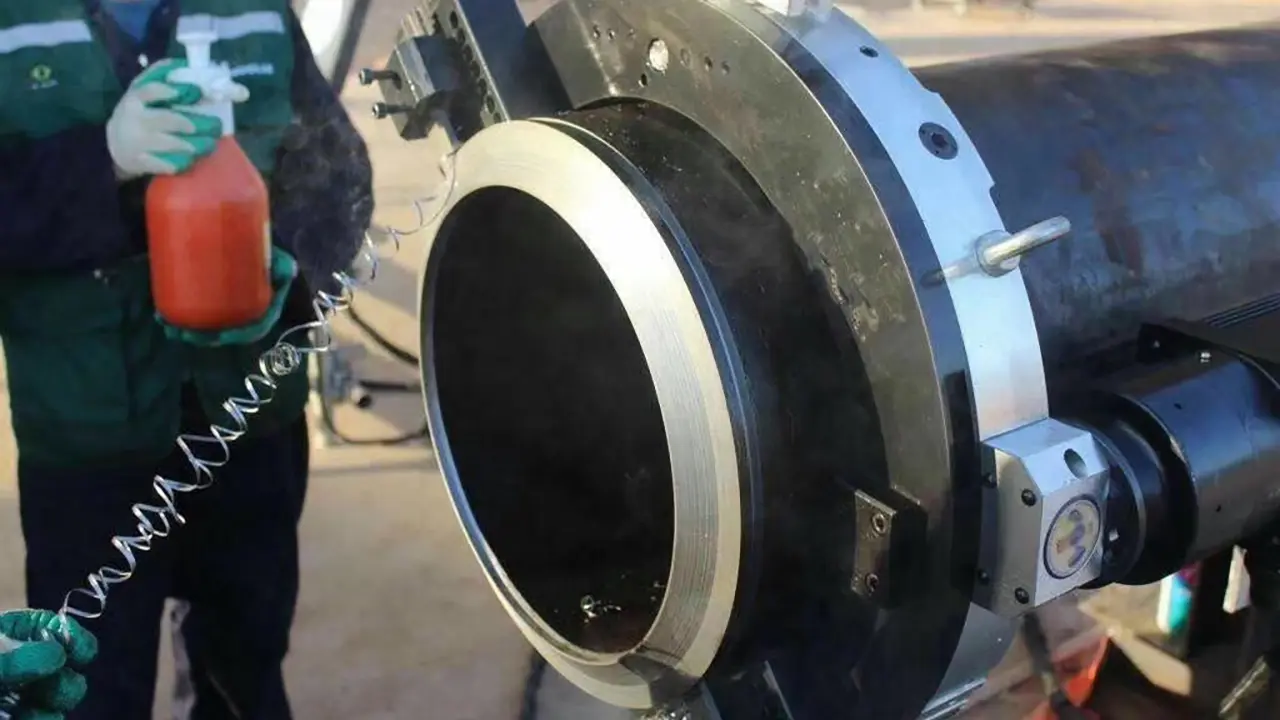
Cold cutting means removing material by mechanical chip formation—the same principle as a lathe, milling machine, or drill. A carbide or HSS tool bit contacts the workpiece, and material is removed as chips. The cutting temperature at the tool-workpiece interface stays below 50°C.
What cold cutting gives you
-
Zero HAZ. No metallurgical change at the cut surface. The microstructure at the cut face is identical to the parent material. No hardness increase, no sensitization, no martensitic transformation.
-
Weld-ready surface finish. A properly set up cold cutting machine produces a surface finish of Ra 3.2–6.3μm—smooth enough to weld directly without grinding. Thermal cutting produces Ra 12–25μm at best and requires grinding to reach weldable condition.
-
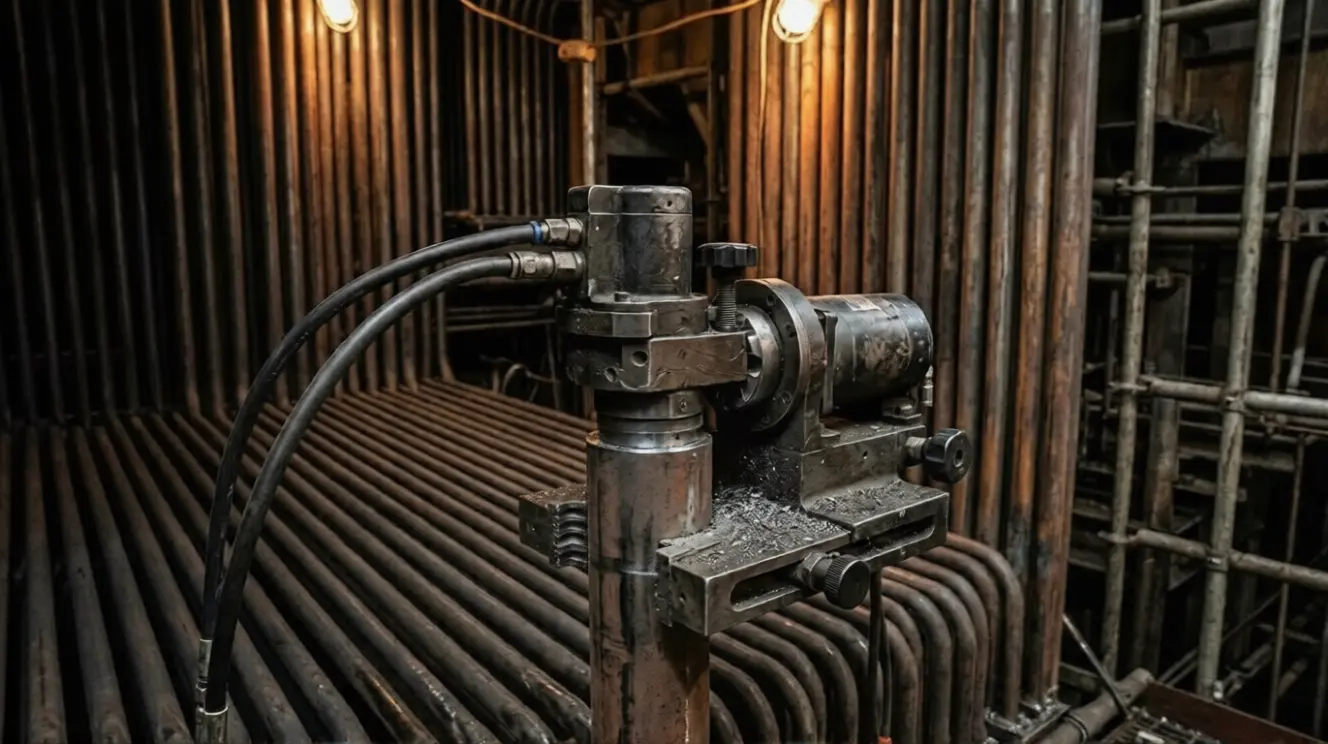
Simultaneous cut and bevel. Machines like the DCM Stationary and Split Frame cut the pipe and machine the bevel in a single operation. No second setup, no second machine, no handling between steps.
-
Dimensional precision. Mechanical cutting with a clamped machine produces consistent, measurable results: ±0.5° bevel angle, ±0.3mm root face. Every cut. Every time. No operator variability.
What cold cutting doesn’t give you
I’m not going to pretend cold cutting is perfect. Here are the real limitations:
-
Slower cutting speed on thick material. A plasma torch cuts 20mm carbon steel in seconds. A cold cutting machine takes minutes. On thin-wall pipe, the difference is small. On 50mm+ walls, thermal cutting is genuinely faster at the cutting step (though not at the total process).
-
Equipment cost. A Planetary pipe cutter starts around $2,000–$4,000. A Split Frame for large-diameter work is $8,000–$30,000+. An oxy-fuel rig is $500. If your budget is the constraint and you’re doing non-code carbon steel work, thermal cutting costs less upfront.
-
Not all materials are equal. Cold cutting works beautifully on carbon steel, stainless steel, chrome-moly, duplex, and most industrial alloys. But extremely hard materials (above ~350 HV) or cast iron can be challenging—tool wear accelerates, and you need rigidity that portable machines sometimes can’t provide.
-
Access constraints. A cold cutting machine needs to clamp to the pipe. If the pipe is in a trench with 50mm clearance, an oxy-fuel torch fits where a Split Frame doesn’t. Real field conditions sometimes dictate the method.
The Real Comparison: Total Process Time
This is the comparison that changes minds. Every shop I talk to that resists cold cutting makes the same argument: “Thermal cutting is faster.” They’re right about the cutting step. They’re wrong about the total process.
Here’s actual timing data from a pipeline prefab shop that tracked both methods on the same pipe spec—8” Schedule 80 P22 chrome-moly:
Oxy-fuel cutting + grinding + separate beveling
| Step | Time |
|---|---|
| Setup and preheat | 5 min |
| Oxy-fuel cut | 4 min |
| Cool down | 3 min |
| Grind slag and oxide layer | 12 min |
| Grind to remove HAZ (min 3mm depth) | 18 min |
| Hardness test | 5 min |
| Re-grind (failed first test, 40% of the time) | 10 min avg |
| Setup beveling machine | 5 min |
| Machine bevel | 8 min |
| Final inspection | 3 min |
| Total | 73 min |
Cold cutting machine (Split Frame, cut + bevel in single pass)
| Step | Time |
|---|---|
| Mount and align Split Frame | 8 min |
| Cold cut + bevel (single operation) | 15 min |
| Remove machine | 3 min |
| Inspection (hardness test not required—no HAZ) | 2 min |
| Total | 28 min |
The “fast” thermal method took 2.6x longer than the “slow” cold cutting method. And this doesn’t include the 40% rework rate on the hardness test—when the HAZ wasn’t fully ground away, the entire grinding and testing cycle repeated.
On P91 chrome-moly, the gap is even worse. P91 requires either complete HAZ removal by machining or a localized PWHT cycle (minimum 2 hours at 740–760°C with controlled heating and cooling). Add that to the oxy-fuel process, and cold cutting is 5–8x faster on a total-process basis.
The consumable cost comparison
| Item | Oxy-fuel Process | Cold Cutting Process |
|---|---|---|
| Cutting consumables per cut | $3–$5 (gas) | $0.50–$1.50 (insert wear) |
| Grinding discs per cut | $4–$8 (2–4 discs) | $0 |
| Beveling inserts per cut | $1–$2 | Included in cutting step |
| Hardness test strips | $2–$3 | Not required |
| Total consumable cost per cut | $10–$18 | $0.50–$1.50 |
Over 1,000 cuts (a typical annual volume for a mid-size prefab shop), that’s $10,000–$18,000 in consumables for thermal cutting versus $500–$1,500 for cold cutting. The cold cutting machine pays for itself in consumable savings alone within the first year.
Where Cold Cutting Is Non-Negotiable
For some applications, cold cutting isn’t a preference—it’s a specification requirement. Here are the situations where thermal cutting will get your work rejected:
1. Chrome-moly alloy steels (P11, P22, P91, P92)
Every major power piping code (ASME B31.1, B31.3, EN 13480) allows thermal cutting of chrome-moly steels only if the HAZ is completely removed by mechanical means before welding. In practice, this means you’re cold cutting the bevel face anyway—thermal cutting just adds an extra step.
Most project specifications for P91 and P92 go further: they prohibit thermal cutting entirely, or require a pre-weld PWHT cycle that adds hours to the schedule. The ISE II-Model handles P91 up to 75mm wall thickness with zero metallurgical impact—exactly the application it was designed for.
2. Austenitic and duplex stainless steels
Thermal cutting stainless steel creates two problems simultaneously: sensitization (loss of corrosion resistance) and oxide contamination on the cut face. Both must be removed before welding. On duplex stainless, thermal cutting can also disrupt the austenite-ferrite phase balance, which is the entire mechanical basis of the alloy.
For stainless pipe under 8mm wall thickness, the Planetary series cuts and optionally bevels in one operation with zero heat input. For heavier walls, the ISE T-Model or Split Frame handles the job.
3. Offshore and subsea piping
Offshore specifications (NORSOK, DNV) are the most restrictive in the industry. Most subsea pipeline specifications prohibit thermal cutting of any kind on the final weld prep surface. The reasoning is straightforward: you can’t afford a premature failure 300 meters underwater because someone left a 2mm hardened layer that initiated a fatigue crack.
4. Nuclear piping
Nuclear code work (ASME Section III) requires full documentation of every process applied to the material. Thermal cutting introduces variables—HAZ depth, hardness changes, potential for hydrogen pickup—that must be tested, documented, and accepted. Cold cutting eliminates all of those variables. Fewer variables = simpler documentation = faster NDE acceptance.
5. Any project with hardness testing requirements
If your project specification includes post-cutting hardness testing (and most code work does), thermal cutting creates a pass/fail risk at every single cut. A cold cutting machine doesn’t generate hardness changes, so the test is a formality rather than a gatekeeping step.
Where Thermal Cutting Still Wins
I sell cold cutting machines for a living, and I’m going to tell you when not to buy one. Because if I’m not honest about limitations, everything else I say loses credibility.
1. Demolition and scrap cutting
If you’re cutting pipe for removal—not for re-welding—thermal cutting is faster, cheaper, and perfectly appropriate. Nobody needs a metallurgically pristine surface on scrap. Use the oxy-fuel torch.
2. Carbon steel, non-code work, thin wall
If you’re cutting Schedule 40 (and lighter) carbon steel for structural or non-code fabrication, the HAZ from plasma cutting is thin enough that normal bevel preparation removes it. A good plasma setup with CNC guidance produces acceptable results faster and cheaper than a cold cutting machine for this specific application.
3. Very thick material (>80mm) in the field
When wall thickness exceeds what portable cold cutting machines can handle, thermal cutting is sometimes the only option. On extreme-wall applications in remote locations—think deep-water pipeline risers at 100mm+ wall—oxy-fuel or plasma may be required for the initial cut, followed by cold mechanical machining of the bevel face. Hybrid approach: thermal cut for speed, cold machine for the weld prep surface.
4. Emergency field repairs
Your cold cutting machine is in the warehouse. The pipe is leaking. The oxy-fuel rig is on the truck. Use the oxy-fuel rig. Common sense overrides metallurgical purity when the plant is shutting down.
5. Budget-constrained, low-volume, non-critical work
A small maintenance shop doing 5 cuts per week on carbon steel water piping doesn’t need a $15,000 Split Frame. Their $800 oxy-fuel setup with a $200 angle grinder works fine. I won’t pretend otherwise.
The Bottom Line
Thermal cutting is not inherently bad. It’s a legitimate process with real advantages in specific applications. But for code-quality weld preparation—especially on alloy steels, stainless steels, and any project with hardness testing requirements—thermal cutting creates downstream costs that far exceed the time it saves at the torch.
Here’s what I’ve learned from supplying pipe cold cutting machines to fabrication shops, pipeline contractors, and power plant maintenance crews across six continents:
- Compare total process time, not cutting time. Thermal cutting is faster at the cut. Cold cutting is faster from raw pipe to weld-ready bevel.
- The HAZ is not a theoretical problem. It’s a measurable, testable metallurgical change that causes real rejections, real rework, and real schedule delays.
- Cold cutting eliminates variables. Fewer variables mean fewer inspections, fewer rejections, and more predictable schedules. Your welding inspector will notice the difference on day one.
- The right method depends on the application. For critical code work: cold cutting. For demolition and non-code carbon steel: thermal. For everything in between: calculate the total process cost and let the numbers decide.
If you’re still using thermal cutting for code work on alloy or stainless steels, I’d be surprised if your rework rate isn’t 15–25% higher than it needs to be. Tell me what you’re cutting—material, wall thickness, code requirement—and I’ll show you the process comparison for your specific case.
Related reading:
- Pipe Cold Cutting Machines: Types, Selection & Applications — Complete guide to clamshell, split frame, and planetary cold cutting machines
- Still Using an Angle Grinder? Here’s What It’s Costing You — The manual vs. automated beveling comparison
- Best Pipe Beveling Machines in 2026: A Selection Guide — Choose the right cold cutting machine for your pipe range
- Pipe Bevel Types: Complete Guide — Choose the right bevel profile for your welding code
Based on metallurgical lab testing, production timing data from customer sites, and field observations across power, pipeline, and offshore applications. I manufacture cold cutting machines—that’s my bias, and I state it clearly. But the metallurgical data doesn’t change based on who presents it: heat damages alloy steel, and mechanical cutting doesn’t. Your welding inspector already knows this.