Why One Page Matters
I’ve watched a qualified welder bevel 40 joints to ASME B16.25 specs—on a project governed by API 1104. Nobody caught it until the CWI flagged the included angle on the first fit-up. 40 pipe ends, re-beveled. Two days lost.
The welder wasn’t incompetent. He’d just come off a refinery turnaround and muscle memory took over. That’s what happens when your crew works across multiple codes and nobody has a quick reference that shows the differences at a glance.
Here’s the problem: there is no single document in the welding world that compares bevel requirements across codes side by side. The ASME book references B16.25. AWS D1.1 has its own Table 2.4. API 1104 defers to the WPS. EN ISO 9692 uses a completely different designation system. Each code lives in its own universe, and fabricators who work across industries are expected to keep it all straight in their heads.
They can’t. Nobody can. So I built this reference.
This isn’t a legal interpretation of any code—I’m a machining specialist, not a code attorney. This is the field-practical comparison I wish someone had given me when I started supplying beveling equipment to shops that work under three different codes in the same month. Always verify against your project-specific WPS and the current edition of the governing code.
The Four Codes You’ll Actually Use
There are dozens of welding codes and standards worldwide. But in my experience supplying pipe beveling machines and plate beveling machines to fabricators across 40+ countries, four code families cover roughly 95% of the bevel specifications you’ll encounter:
| Code | Scope | Who uses it | Where it applies |
|---|---|---|---|
| ASME B16.25 / B31.3 | Process piping | Refineries, chemical plants, power plants, pharma | Welded pipe systems in process facilities |
| AWS D1.1 | Structural steel | Steel fabricators, bridge builders, building frames | Structural welded connections |
| API 1104 | Pipelines | Pipeline contractors, oil & gas transmission | Cross-country and offshore pipelines |
| EN ISO 9692 | General (European) | European fabricators, shipyards, EU-regulated projects | Any project under European directives |
The other 5% includes ASME Section III (nuclear), DNV GL (offshore structures), military specs, and industry-specific codes. Those are specialized enough that if you’re working under them, you already have a dedicated welding engineer telling you what to do.
Master Comparison Table
This is the table that doesn’t exist in any code book. I’ve built it from the four codes’ current editions and validated it against hundreds of WPSs I’ve seen from client projects.
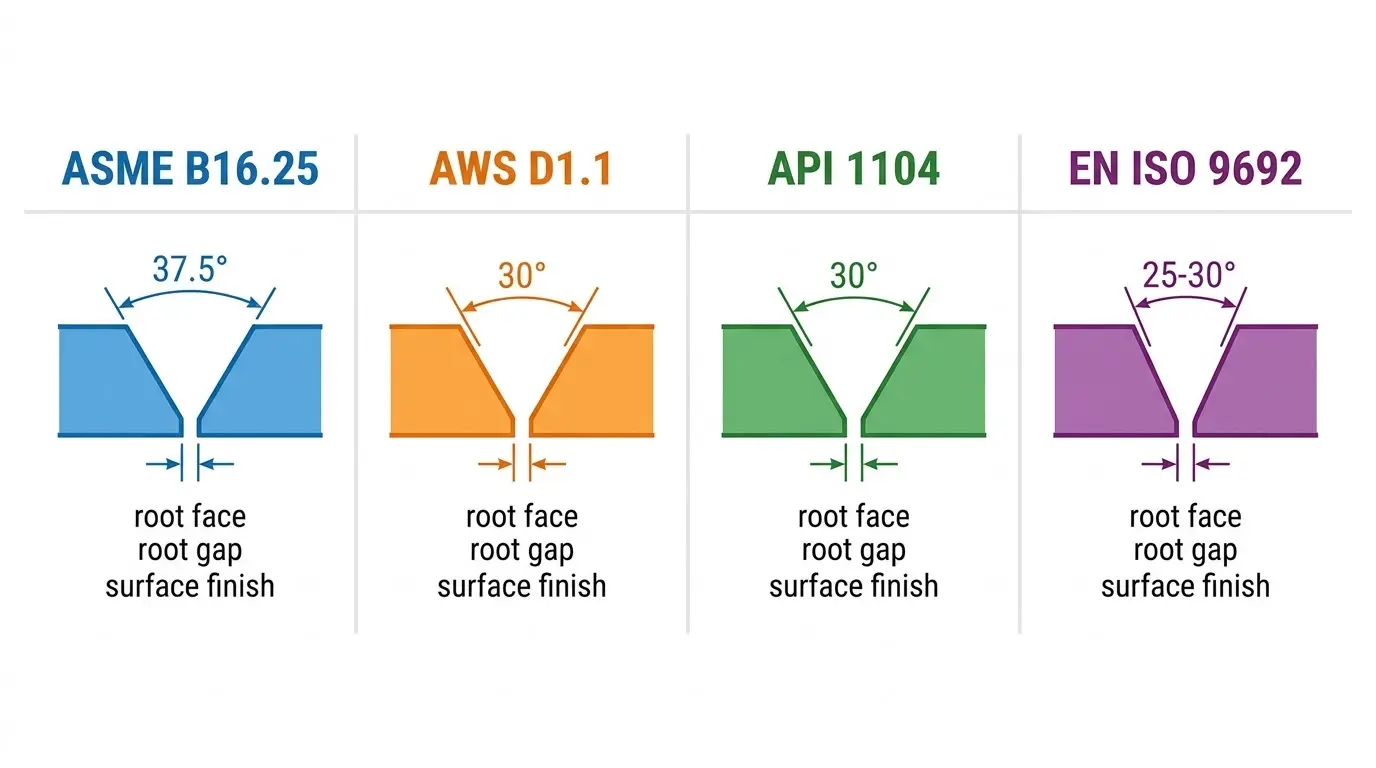 Side-by-side bevel requirements across the four major welding codes. The numbers look similar—the differences are what get you rejected.
Standard V-Groove Butt Weld (the joint everyone uses)
| Parameter | ASME B16.25 / B31.3 | AWS D1.1 (PJP B-U2a) | API 1104 | EN ISO 9692-1 |
|---|---|---|---|---|
| Bevel angle | 37.5° ± 2.5° | 30° (min) | 30° ± 5° (per WPS) | 25°–30° (per designation) |
| Included angle | 75° ± 5° | 60° (min) | 60° ± 10° (per WPS) | 50°–60° |
| Root face | 1.6mm ± 0.8mm | 0–3mm (per detail) | 1.6mm ± 0.8mm (per WPS) | 1–2mm (per designation) |
| Root gap | Per WPS (typ. 0–3mm) | Per detail (0–6mm) | 1.6mm ± 0.8mm (per WPS) | 0–4mm (per designation) |
| Hi-Lo max | Per B31.3 Table 328.4.3 | 1.6mm (typ.) | 1.6mm | Per EN standard |
| Surface finish | Per B16.25 §5 | 1000 µin Ra (thermal) | Clean, no contaminants | Per ISO 8501/EN standard |
| Bevel designation | References B16.25 Fig. | Table 2.4 / Fig. 2.4 | Per qualified WPS | ISO 9692-1 designation |
Warning: this table is simplified for quick reference. Each code has dozens of joint configurations for different geometries, thicknesses, and welding processes. This covers the single most common joint: a standard V-groove butt weld on pipe or plate. For compound bevels, J-grooves, U-grooves, and special configurations, you need the full code.
ASME B16.25 and B31.3: Process Piping
ASME’s approach to beveling is the most structured—and the most referenced.
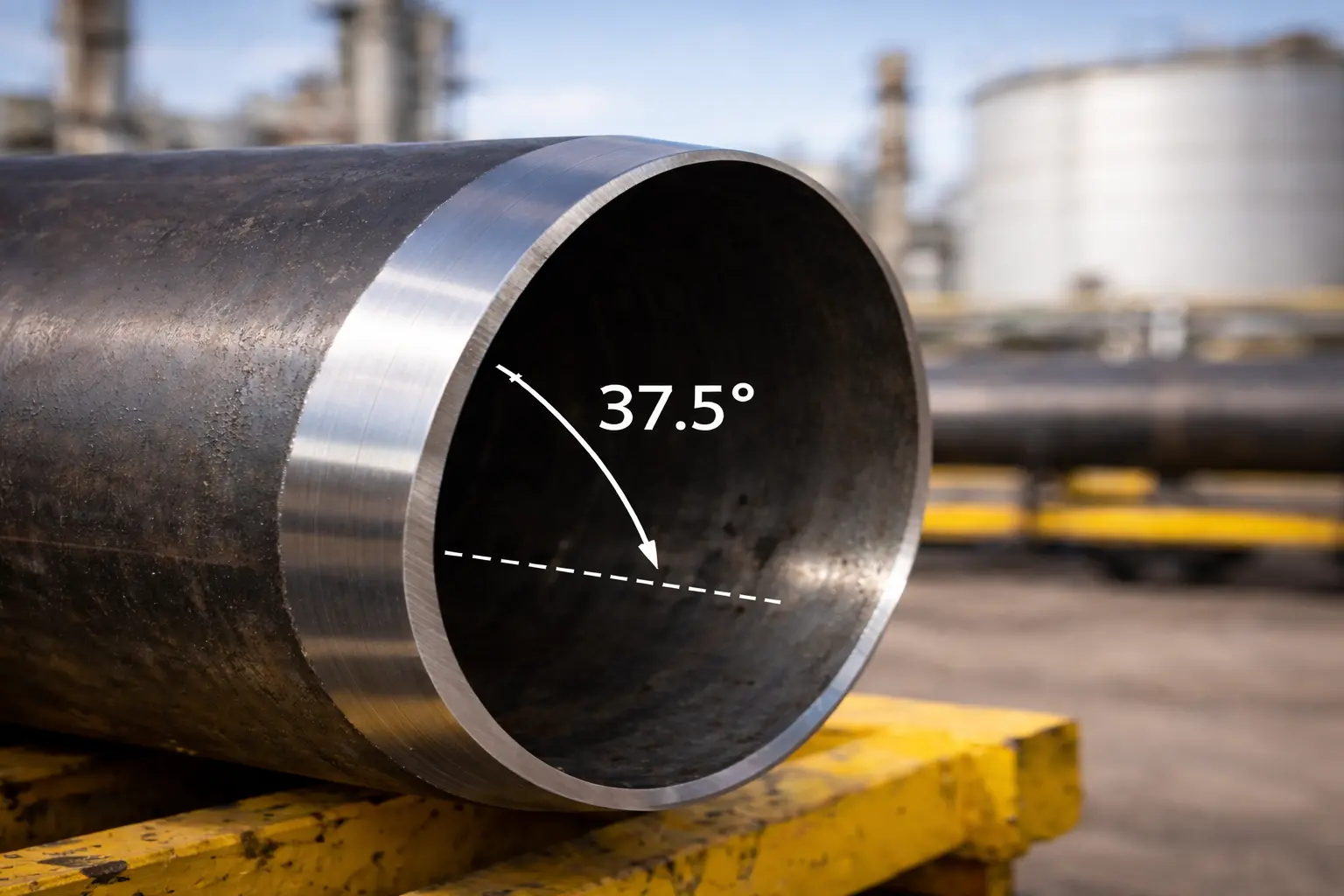
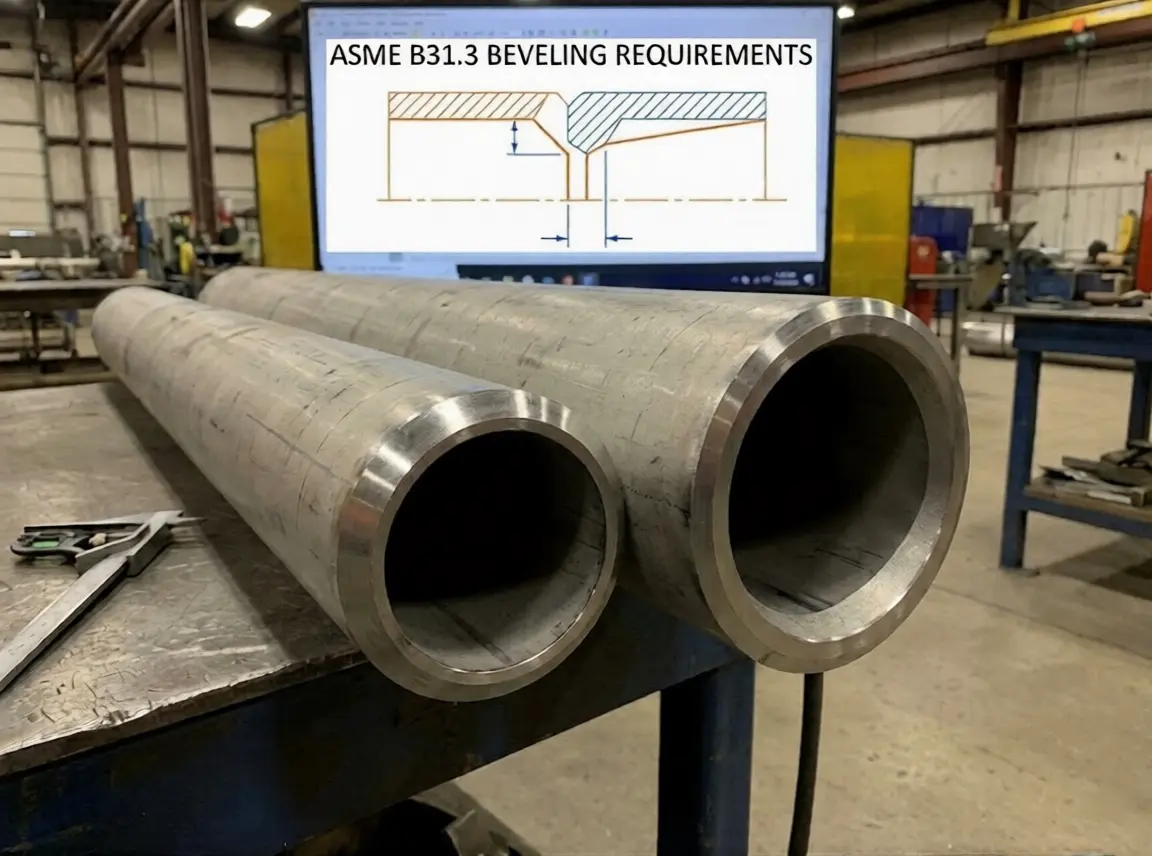
B31.3 (Process Piping) doesn’t define bevel geometry directly. It points you to ASME B16.25 (Buttwelding Ends) for weld end preparation details. B16.25 then gives you the actual dimensions: 37.5° bevel angle, 1.6mm root face, specific tolerances for wall thickness ranges.
What makes ASME different
- 37.5° is the default bevel angle. This is the number that lives in every process piping welder’s head. It produces a 75° included angle—wider than pipeline or structural work.
- B16.25 covers the weld end, B31.3 covers the fit-up. Alignment tolerances (hi-lo) are in B31.3 Table 328.4.3, not B16.25. Shops that only read B16.25 miss the fit-up requirements.
- Material-specific requirements exist. B31.3 has special rules for P91/P92 chrome-moly, duplex stainless, and other alloys—including preheat and surface condition requirements that affect bevel prep.
I’ve written a deep dive on this: ASME B31.3 Beveling Requirements covers everything from B16.25 weld end prep to the material-specific traps that catch fabricators off guard.
The ASME trap I see most often
Shops assume that because pipe fittings (elbows, tees) come with a factory-machined 37.5° bevel, they should match it exactly. But B16.25 allows ±2.5° on the bevel angle. A pipe end beveled at 35° mating with a fitting at 37.5° gives you a 72.5° included angle—still within code, but the welder has to compensate for the asymmetry. Most don’t notice, and most of the time it doesn’t matter. But on critical joints with 100% RT, the asymmetric root profile can show up as a marginal indication.
AWS D1.1: Structural Steel
AWS D1.1 takes a fundamentally different approach: prequalified joint details.
Instead of specifying a single bevel angle with a tolerance, D1.1 gives you a table of complete joint configurations (Table 2.4) with specific dimensions for each. You pick the joint detail that matches your application, and every dimension—bevel angle, root face, root opening, backing bar—is defined for that configuration.
What makes AWS different
- Shallower bevel angles. D1.1 prequalified joints typically use 30° or 45° bevels (60° or 90° included), not the 37.5° of ASME piping.
- Tighter surface roughness. AWS D1.1 Section 5.15.4.3 requires thermal-cut surfaces to be ≤1000 µin (25 µm) Ra. This is stricter than most shops realize—and stricter than oxy-fuel cutting typically achieves without grinding.
- Root opening varies by joint type. Some D1.1 prequalified joints spec a 6mm (1/4”) root gap with a backing bar. Others spec 0mm root gap with a 3mm root face for open-root welds. The numbers depend entirely on which joint detail you’re using.
Full breakdown here: AWS D1.1 Structural Steel Beveling covers prequalified joint details, the surface roughness trap, and where I see structural shops failing CWI inspection.
The AWS trap I see most often
Shops use a plasma torch to cut the bevel and assume the surface is ready to weld. It’s not. Plasma cutting on structural steel typically produces a surface roughness of 1500–2500 µin—well above the 1000 µin limit in D1.1. The inspector pulls out a comparator gauge, and suddenly every bevel face needs grinding. A plate edge milling machine produces surfaces under 500 µin—no post-cut grinding required.
API 1104: Pipelines
API 1104 is the simplest code to read—and the most deceptive.
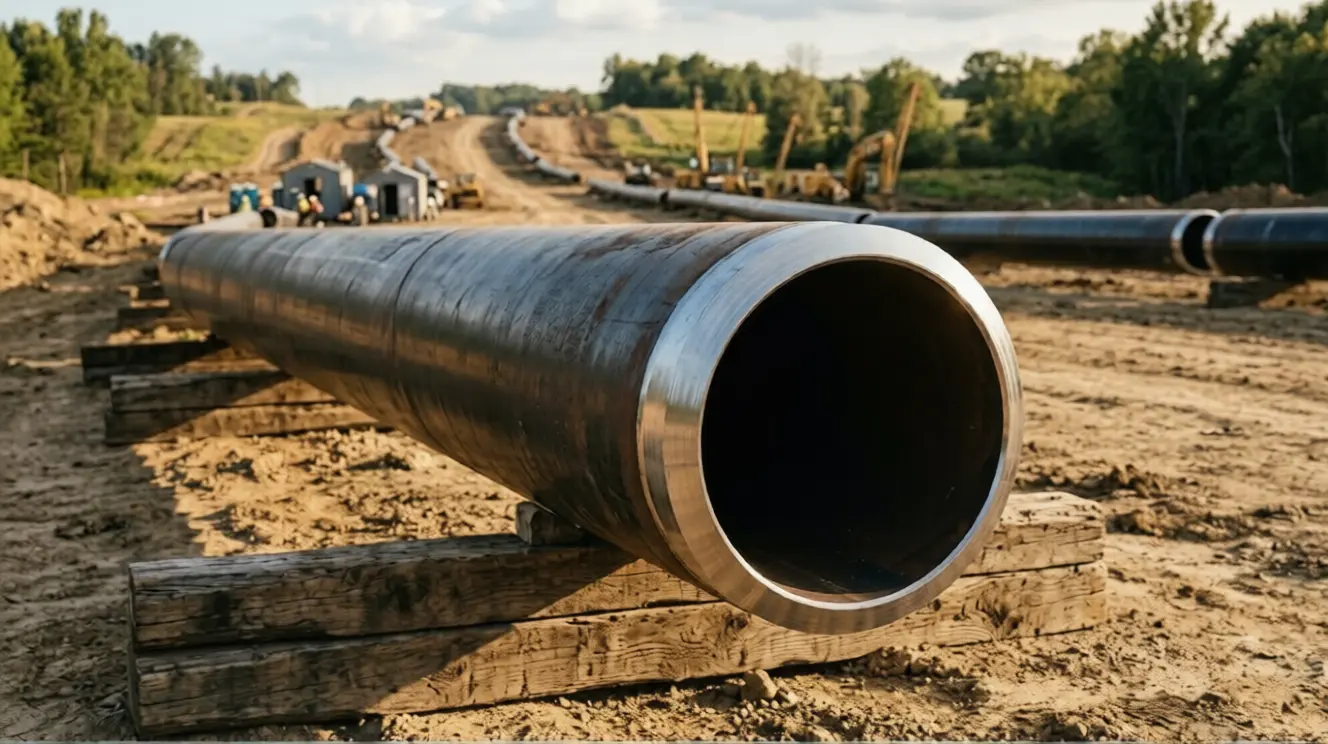
Where ASME and AWS specify exact geometry in the code itself, API 1104 defers almost everything to the qualified welding procedure specification (WPS). The code sets the framework, the WPS sets the numbers. In practice, though, virtually all pipeline WPSs use the same geometry: 30° bevel, 1.6mm root face, 1.6mm root gap. Pipeline welders call 1104 “the sixteenth-inch code” because every critical dimension is 1/16” (1.6mm).
What makes API 1104 different
- 30° bevel / 60° included angle. Narrower than ASME’s 75°. The pipeline welding technique (downhill progression with cellulosic electrodes) needs a narrower groove to minimize fill passes across thousands of field welds.
- Everything is 1.6mm. Root face, root gap, hi-lo maximum—all 1.6mm. Simple to remember, zero margin for error.
- Field conditions dominate. API 1104 is written for welding in ditches, on mountainsides, and in extreme weather. The tolerances reflect what’s achievable in the field—but they still have to be met, and field beveling equipment has to deliver.
Detailed guide here: API 1104 Pipeline Beveling covers root gap variation, field vs. shop beveling, and what fails RT on pipeline projects.
The API 1104 trap I see most often
A welder comes from process piping work (ASME B31.3) to a pipeline project (API 1104) and bevels at 37.5° out of habit. The included angle is 75° instead of 60°. Each joint takes 30–40% more filler metal and 1–2 extra fill passes. On a pipeline with 4,000+ welds, that habit costs weeks of schedule and tons of unnecessary consumables—even though the weld quality itself might be fine.
EN ISO 9692: European Standard
EN ISO 9692 is the standard most non-European fabricators haven’t read—until they get a European project and realize their entire bevel reference framework doesn’t translate.
What makes EN ISO 9692 different
- Designation system instead of a single spec. EN ISO 9692 defines joint types by designation (e.g., “1.3” for a V-butt with root gap) rather than giving a single default angle. Each designation includes an acceptable range for bevel angle, root face, and root gap.
- Multiple parts for different materials. 9692-1 covers steel, 9692-2 covers aluminum—each with material-appropriate geometry ranges.
- Angle ranges are wider. Where ASME gives you 37.5° ± 2.5° and API gives you 30° ± 5°, EN ISO 9692 might specify a range of 20°–30° for a given designation. The WPS narrows it down—but the code itself is more permissive.
- Integrated with EN ISO 15614 (WPQR). The bevel geometry in 9692 must align with what was qualified during the welding procedure qualification—everything links back to the pWPS and WPQR.
The EN trap I see most often
Fabricators who normally work under ASME or AWS take a European project and assume the bevel geometry is interchangeable. It’s not—mainly because the documentation requirements are different. Under EN, you need to demonstrate that your bevel geometry matches the pWPS that was qualified per EN ISO 15614. Having an ASME Section IX PQR doesn’t satisfy this, even if the numbers are identical. European inspectors check the paperwork chain, not just the dimensions.
The Differences That Bite You
Most of the time, most of these codes produce similar bevels. A 30° bevel is close to a 37.5° bevel. A 1.6mm root face is close to a 2mm root face. The problems happen at the boundaries—when you assume one code’s rules apply under another code’s jurisdiction.
Difference #1: Bevel angle (the big one)
| Code | Default bevel angle | Why |
|---|---|---|
| ASME B16.25 | 37.5° | All-position welding, weave technique, wider access |
| AWS D1.1 | 30° or 45° | Depends on prequalified joint detail |
| API 1104 | 30° | Downhill stringer technique, minimize fill passes |
| EN ISO 9692 | 25°–30° range | WPS-specific within code range |
Why it matters: A welder moving between ASME piping and API pipeline work is switching between a 75° groove and a 60° groove. That’s a massive difference in weld volume, pass count, and technique. If the bevel doesn’t change when the code changes, either you’re over-filling (wasting time and money) or under-penetrating (failing inspection).
Difference #2: Surface finish requirements
| Code | Surface requirement | Practical implication |
|---|---|---|
| ASME B16.25 | Workmanship standard, remove oxide | Grinding or machine cutting |
| AWS D1.1 | ≤1000 µin Ra for thermal cuts | Measured, inspectable, enforceable |
| API 1104 | Clean, free of contaminants | Oxide layer from oxy-fuel = problem |
| EN ISO 9692 | Per EN/ISO surface standards | Varies by project spec |
Why it matters: AWS D1.1 is the only code among the four that gives you a hard surface roughness number. Shops that only do ASME or API work get surprised by the D1.1 requirement when they pick up a structural contract.
Difference #3: How the code specifies geometry
| Code | Specification method | What this means for your shop |
|---|---|---|
| ASME | B16.25 provides standard weld end prep | One geometry, match to WPS |
| AWS | Prequalified joint details in Table 2.4 | Pick the right detail, use those exact numbers |
| API | WPS-driven (code sets framework) | Qualify it, then hold it |
| EN | Designation system with ranges | Match pWPS per EN ISO 15614 |
Why it matters: In ASME and API, the welder and fitter work from the WPS. In AWS, they work from the joint detail. In EN, they work from the pWPS/WPQR package. The source-of-truth document is different, and grabbing the wrong reference causes errors.
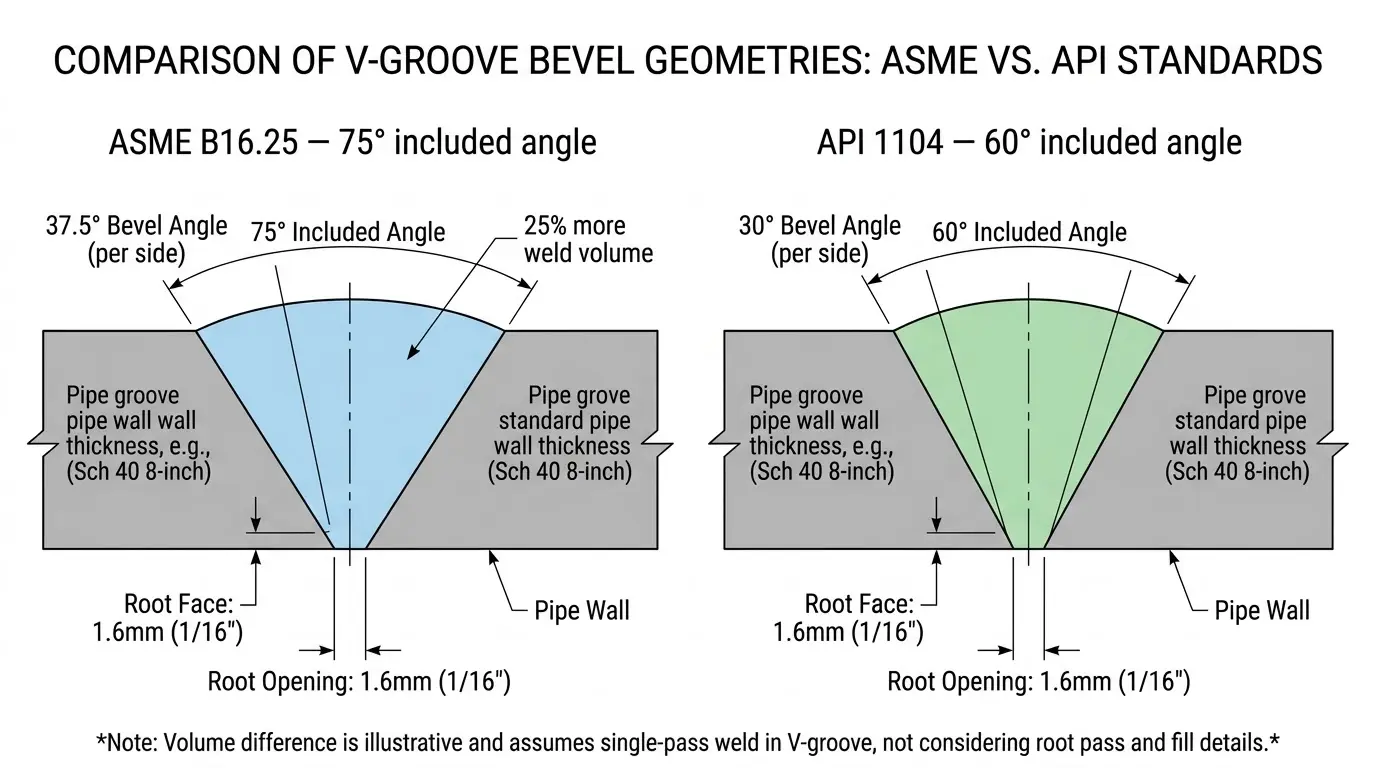 The same “V-groove bevel” means different geometry under different codes. ASME’s 37.5° produces a 75° groove—25% wider than API 1104’s 60° groove. Different welding techniques, different optimal angles.
Which Code Governs Your Project
If you’re not sure which code applies, here’s the decision tree I use when a customer calls and says “I need a bevel machine for my project”:
What are you welding?
- Pipe in a process facility (refinery, chemical plant, power plant, pharma) → ASME B31.3 (or B31.1 for power piping)
- Structural steel (buildings, bridges, platforms) → AWS D1.1 (or D1.5 for bridges)
- Cross-country pipeline or station piping → API 1104
- Any of the above in the EU or under European contract → EN ISO 9692 (plus the relevant EN welding standard)
- Pressure vessels → ASME Section VIII (references B16.25 for weld end prep)
- Nuclear → ASME Section III (talk to your welding engineer, not a blog post)
But here’s the catch: many projects combine multiple codes. A pipeline terminal has API 1104 for the incoming pipeline, ASME B31.3 for the station piping, and AWS D1.1 for the structural supports. Three codes, one project, one bevel crew. This is exactly where the confusion starts—and why a quick-reference comparison like this article matters.
Equipment Implications
Different codes don’t just mean different angles—they mean different equipment requirements. Here’s what I’ve learned from equipping multi-code shops:
Single-code shops
If you only work under one code, your equipment choice is straightforward:
- ASME B31.3 shops: An ID-mount pipe beveling machine set to 37.5° handles 90% of your work. The ISE-T series covers the typical process piping range with the consistency needed for RT-quality joints.
- AWS D1.1 shops: A plate edge milling machine that holds ≤1000 µin surface finish eliminates the post-cut grinding that slows down every thermal-cut bevel.
- API 1104 pipeline crews: A split frame clamshell machine that clamps to the pipe OD and produces consistent root faces in field conditions.
Multi-code shops (where it gets interesting)
If your shop works across codes—and most larger fabricators do—you need equipment with adjustable bevel angles. This sounds obvious, but I’ve seen shops buy fixed-angle tooling for their most common code and then grind the bevel by hand when a different code’s project comes in. That’s backwards.
The right approach: invest in beveling equipment with adjustable compound angle capability. Set the angle per the WPS/joint detail for each project. Verify with a bevel gauge before the first weld. The machine doesn’t care whether it’s cutting 30° for API 1104 or 37.5° for ASME B16.25—it just needs to be told.
The real savings aren’t in the equipment—they’re in the eliminated rework. One batch of joints beveled at the wrong angle can cost more in re-prep time than the equipment itself.
The Bottom Line
After years of supplying beveling equipment to fabricators who work under every major welding code, here’s my condensed assessment:
- The codes agree on more than they disagree. V-groove butt welds with 25°–37.5° bevel angles, 1–3mm root faces, clean surfaces. The fundamentals are universal.
- The differences are subtle but expensive. 37.5° vs. 30° doesn’t sound like much—until it’s 4,000 pipeline joints with an extra fill pass each.
- The most dangerous moment is code transition. When a welder or a shop moves from one code to another, muscle memory overrides documentation. Having a visible quick reference eliminates the most common errors.
- Surface finish is the hidden variable. Most codes don’t give you a hard number, so shops ignore it. Then they get a D1.1 project and discover their plasma-cut surfaces are 2x over the roughness limit.
- Your equipment should be code-agnostic. Buy machines that adjust to any angle, not machines that lock you into one code’s geometry.
If you’re setting up a bevel prep process for a multi-code shop, or you’ve had rework issues that trace back to bevel geometry mismatches, I can help you select the right combination of equipment for your code mix. Tell me:
- Which codes you work under (and how often each)
- Pipe diameter and wall thickness range (or plate thickness range)
- Current beveling method (grinder, flame cut, existing machine)
- Your biggest rework problem (what keeps failing inspection)
I’ll recommend a setup that covers your code requirements and pays for itself in eliminated rework.
Dive deeper into each code:
- Pipe Bevel Angles & Code Requirements — Angle selection logic across all major codes
- ASME B31.3 Beveling Requirements — Process piping deep dive
- AWS D1.1 Structural Steel Beveling — Structural code tolerances and the roughness trap
- API 1104 Pipeline Beveling — Pipeline field beveling requirements
- Cold Cutting vs Thermal Cutting — Why the cutting method matters for code compliance
Based on ASME B16.25-2022, ASME B31.3-2022, AWS D1.1/D1.1M:2020, API 1104 22nd Edition, and EN ISO 9692-1:2013. Code requirements change between editions—always verify against the edition specified in your project contract. This guide is a practical reference, not a code interpretation. When in doubt, your project welding engineer or AI (Authorized Inspector) has final authority.