The Outage Clock Is Always Running
Here’s a scene I’ve watched unfold at power plants on three continents: a maintenance crew shows up for a planned outage with 180 waterwall tube replacements on the schedule. They’ve got two weeks. The boilermakers are experienced. The welders are qualified. Everything is lined up—except the tube prep.
Day one, the crew starts beveling with angle grinders. By day three, they’re behind schedule. The bevels are inconsistent—some too steep, some too shallow, root faces all over the place. The welding inspector rejects 15% of the preps. Every rejection means re-grinding, re-inspecting, and the fitters standing around waiting.
By day five, the project manager is on the phone with me asking if I can overnight a set of pipe beveling machines.
I’ve seen this exact scenario at coal-fired plants in India, combined-cycle facilities in Turkey, and nuclear stations in France. The pattern is always the same: the work isn’t difficult, but the volume and time pressure expose every inefficiency in the prep process.
This guide is what I wish those project managers had read before the outage started.
What Makes Boiler Tubes Different
Boiler tube beveling isn’t the same as general pipe beveling, and people who treat it that way burn through time, tooling, and money. Here’s what’s different:
The size range is narrow but critical
Most boiler tubes fall between 25mm and 76mm OD, with wall thicknesses from 3mm to 12mm. That’s a narrow band—but the general-purpose pipe beveling machines optimized for 6” or 8” process pipe are oversized, overweight, and too slow to clamp for this work.
You need something designed for this exact range. General-purpose machines are like using a sledgehammer to hang a picture frame.
Access is terrible
Waterwall tubes are spaced 50–75mm apart. Superheater tubes can be even tighter. Your machine has to fit between adjacent tubes, clamp securely, and operate without hitting anything around it. Many machines that work fine on a bench can’t physically fit into a boiler tube bank.
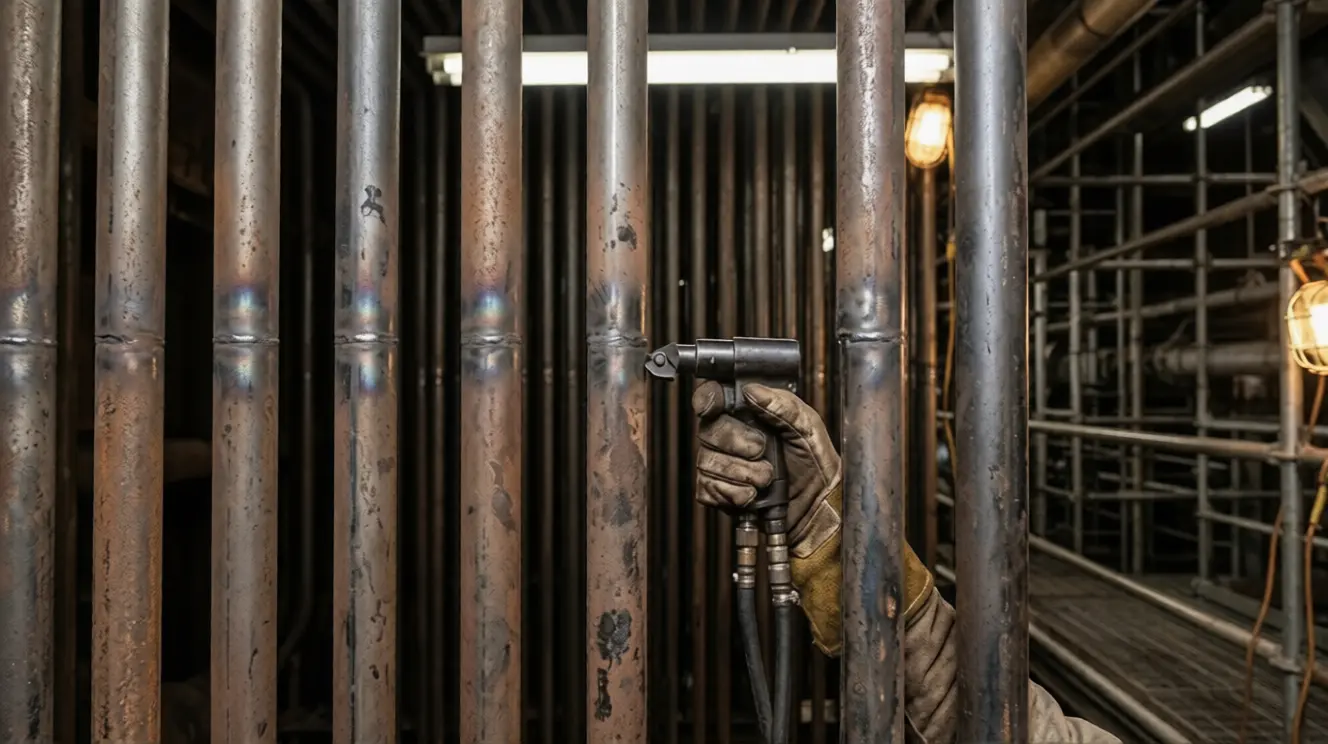 Typical waterwall tube spacing: 50–75mm center-to-center. Your beveling machine has to work in this space—not on a demonstration bench.
The materials fight back
Power plant tubes aren’t mild steel. You’ll encounter:
- SA-210 Grade A1 — carbon steel waterwall tubes (the easy ones)
- SA-213 T11/T22 — chrome-moly superheater and reheater tubes
- SA-213 T91/T92 — advanced ferritic steels in modern supercritical boilers
- SA-213 TP304H/TP347H — austenitic stainless in high-temperature sections
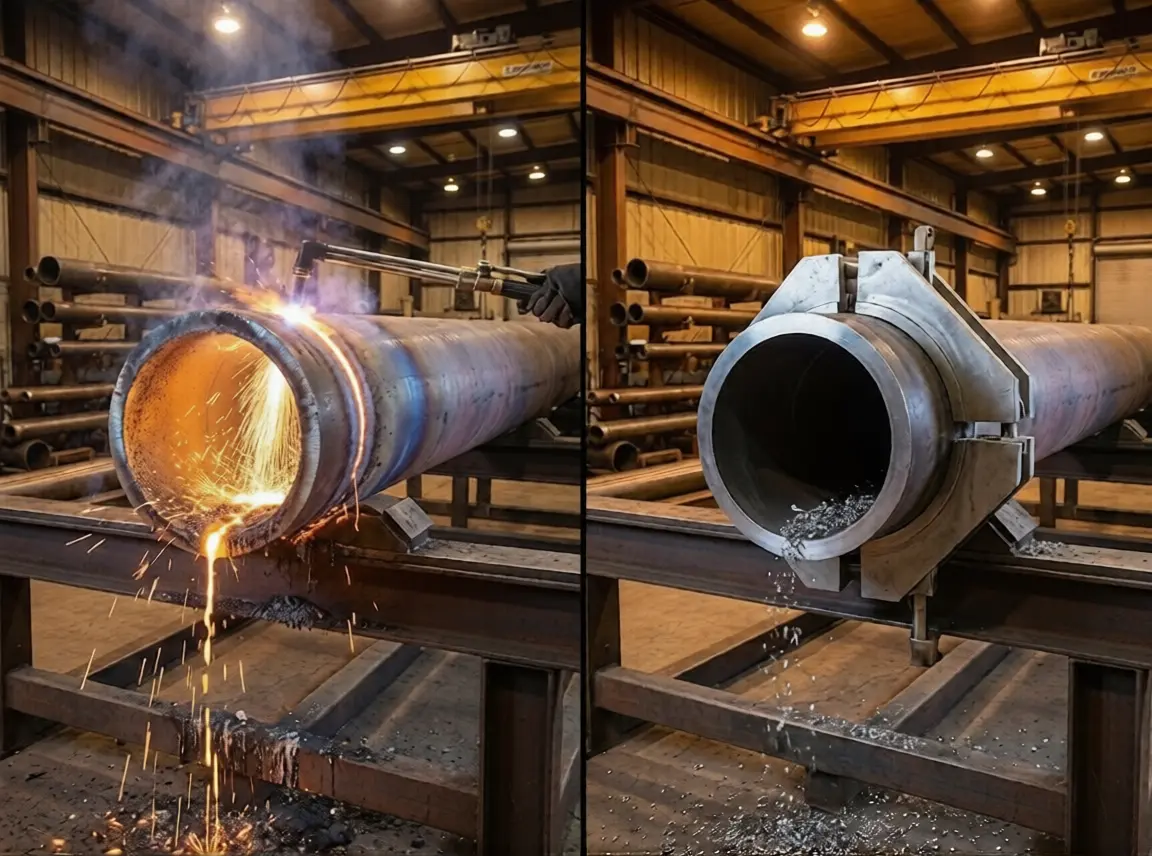
Each of these materials has different hardness, different machining characteristics, and different requirements for what you can and can’t do to the cut surface. T91 in particular will punish you if your cutting process generates too much heat—the material is sensitive to thermal cycling, and a heat-affected zone on a T91 bevel face means mandatory post-weld heat treatment that wasn’t in the original plan.
That’s why cold cutting matters so much in power plant work. Mechanical beveling machines don’t generate the heat that thermal methods do, so you avoid the metallurgical headaches before they start.
Volume is extreme
A single waterwall panel replacement might involve 80–120 tube ends. A full outage can require 200–400 bevels. At that volume, even small improvements in per-bevel time create massive schedule impact:
| Per-bevel time | 200 bevels | 400 bevels |
|---|---|---|
| 15 min (angle grinder) | 50 hours | 100 hours |
| 5 min (wrong machine) | 17 hours | 33 hours |
| 2 min (right machine) | 7 hours | 13 hours |
The difference between 100 hours and 13 hours isn’t marginal—it’s the difference between finishing the outage on time or paying penalty rates for every extra day.
The Carbide Problem
This is the reason for the title of this article, and it’s the single most common complaint I hear from power plant contractors.
Why inserts wear out so fast
Standard carbide inserts are designed for carbon steel. They work fine on SA-210 waterwall tubes—you can prep 30–50 tube ends per insert, depending on wall thickness.
Put those same inserts on T22 chrome-moly, and you’ll get 10–15 tubes before the edge is gone. On T91, sometimes fewer than 10.
The contractors who burn through carbide are usually making one of three mistakes:
Mistake 1: Wrong insert grade
Carbide grades matter. C2 uncoated carbide works for carbon steel. For chrome-moly and stainless, you need a coated insert—TiAlN or TiCN coating dramatically extends tool life on harder materials. I’ve seen the right coating triple insert life on T22 tubes.
Ask your machine supplier what insert grades they offer. If the answer is “one standard grade for everything,” that’s a problem.
Mistake 2: Too much speed, too little feed
Operators instinctively run the RPM high to “cut faster.” On hard alloy tubes, high speed with light feed creates friction heat instead of chip formation. The insert glazes over, stops cutting, and wears by abrasion instead of normal flank wear.
The fix is counterintuitive: slow down the RPM and increase the feed rate. You want to form a chip, not rub the surface. A proper chip carries heat away from the insert. Rubbing keeps the heat at the cutting edge.
Mistake 3: No coolant on stainless
Austenitic stainless (TP304H, TP347H) work-hardens during cutting. If your first pass doesn’t cut deep enough, the surface hardens, and the second pass has to cut through hardened material. It’s a downward spiral that destroys inserts.
A small amount of cutting fluid on stainless tubes extends insert life by 3–5x. Some machines have provisions for a drip bottle or mist system. If yours doesn’t, a shop rag with cutting oil applied to the tube end before each cut works surprisingly well.
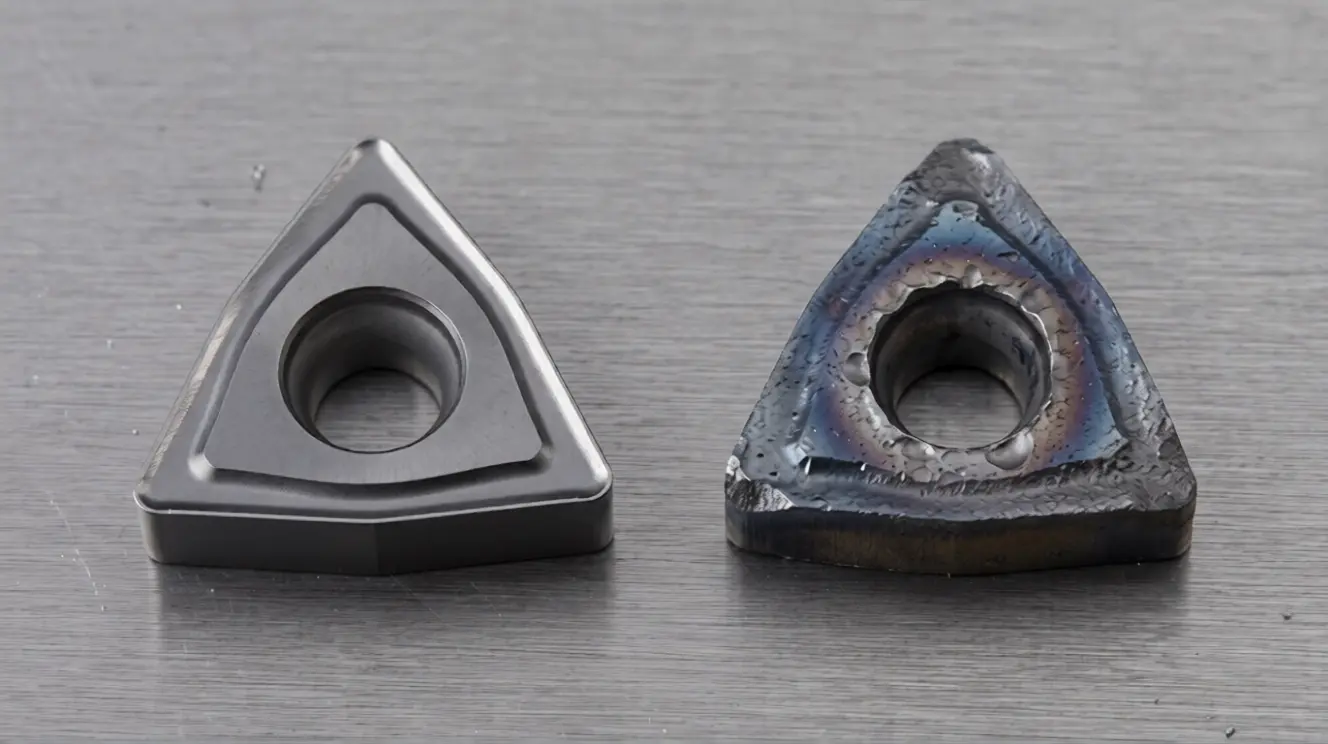 Left: normal flank wear after 40 carbon steel tubes—insert still has life. Right: heat damage after 8 chrome-moly tubes at too-high RPM—insert is finished.
Tube Types and What Each Demands
Waterwall tubes
- Material: SA-210 A1 (carbon steel), occasionally T11
- OD range: 51–76mm typical
- Wall: 5–8mm
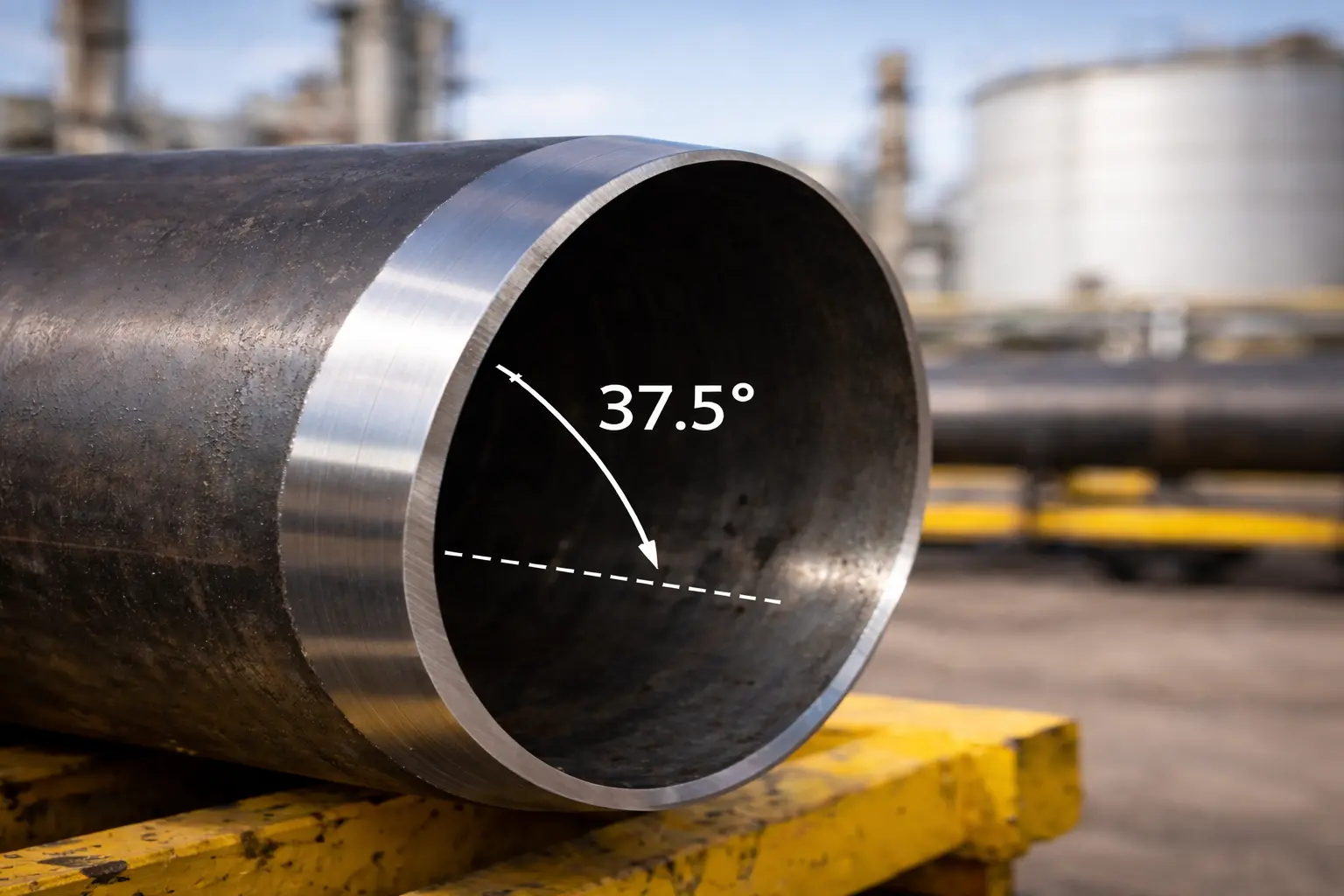
- Bevel: 37.5° V-bevel, 1.6mm root face standard
- Difficulty level: Low—this is the straightforward work
- Key concern: Volume and speed. You might have 100+ tubes to prep in a tight window
Superheater / reheater tubes
- Material: T22 (2.25Cr-1Mo), T91 (9Cr-1Mo-V)
- OD range: 38–64mm typical
- Wall: 4–8mm
- Bevel: Per WPS, typically 37.5° with tighter root face tolerance
- Difficulty level: Medium—harder material requires proper insert selection
- Key concern: Metallurgical integrity. T91 requires cold cutting, no exceptions
Economizer tubes
- Material: SA-210 A1, SA-178
- OD range: 38–51mm typical
- Wall: 3–5mm
- Bevel: Light bevel, often just a facing operation for thin walls
- Difficulty level: Low—thin walls, soft material
- Key concern: Not over-machining. Thin walls don’t need aggressive bevels
High-temperature headers and downcomers
- Material: T22, T91, sometimes P91/P22 forged
- OD range: 100–300mm+
- Wall: 15–40mm
- Bevel: J-prep or compound bevel per ASME B31.1 requirements
- Difficulty level: High—thick walls, hard material, complex bevel geometry
- Key concern: These are not tube-class machines. You need an ID-mount beveler or even the ISE II-Model for the heavy walls
Machine Selection for Boiler Tube Work
After 15+ years of supplying machines to power plant contractors, I’ve narrowed the recommendation to three machines. Each covers a different scenario.
For waterwall panels and high-volume tube prep: ISC Block Type
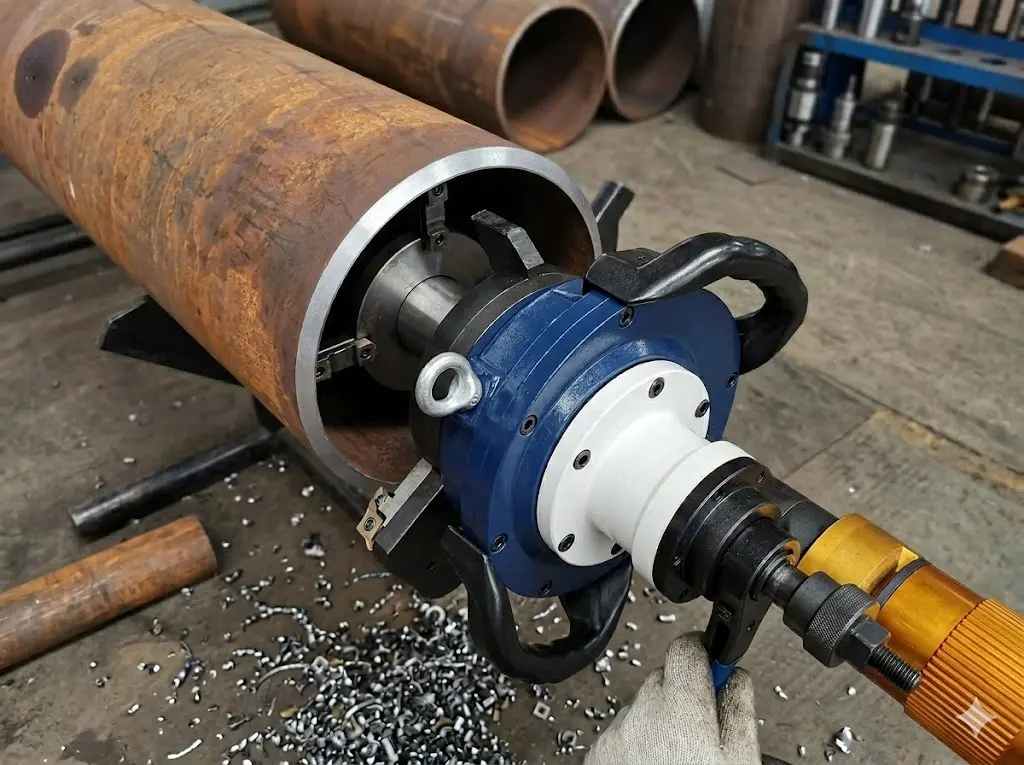
The ISC Block Type was designed for exactly this work. Fixed block clamping on the tube OD, compact enough to fit between adjacent tubes, and rigid enough to produce consistent bevels all day.
- Pipe range: 25–114mm OD
- Wall thickness: up to 12mm
- Weight: 8–11kg depending on model
- Why it wins here: The block clamp is faster than screw-type clamps when you’re doing 100+ tubes. Clamp, bevel, release—15–20 seconds per tube on waterwall. And the rigid clamping eliminates the chatter that destroys inserts on harder materials.
I won’t pretend it’s the fastest machine to set up for the first tube. But by tube number 10, your operator has the rhythm, and by tube 50 they’re not thinking about it anymore.
For tight-access superheater work: Cam-Type
When the tube spacing is too tight for the Block Type—which happens on some superheater designs—the Cam-Type is smaller and lighter:
- Pipe range: 14–114mm OD
- Weight: under 10kg (aluminum body)
- Setup: 5–10 seconds (cam-lever, one action)
- Trade-off: Less rigid than the Block Type, which means more chatter risk on T22/T91. Fine for carbon steel waterwall tubes, marginal for chrome-moly
For tube end facing and squaring: LPM
Sometimes you don’t need a bevel at all. Thin-wall economizer tubes and tubes being prepared for orbital welding need a clean, square face—not a bevel. This is where pipe facing machines come in—the LPM Pipe Facing series does this:
- Pipe range: 3–114mm OD
- What it does: Faces the tube end perfectly square, with optional light chamfer
- Why it matters: Orbital welding requires tube end squareness within 0.1mm. You can’t achieve that with a grinder—you need a facing machine
If your work involves orbital TIG on boiler tubes, tube end squareness is the spec that determines weld quality, not bevel angle.
What I wouldn’t recommend
Angle grinders. Not for 200-tube outages. I’ve covered this in detail in the angle grinder comparison, but the short version: grinders are inconsistent, slow at volume, and generate sparks in environments where you may have insulation, scaffolding, and other fire hazards nearby.
Oversized ID-mount machines. The ISE T-Model is an excellent machine—for 4” and up. Trying to use it on 2” boiler tubes is like driving a truck through a parking garage. It’ll technically fit some of the tubes, but it’s not designed for the work.
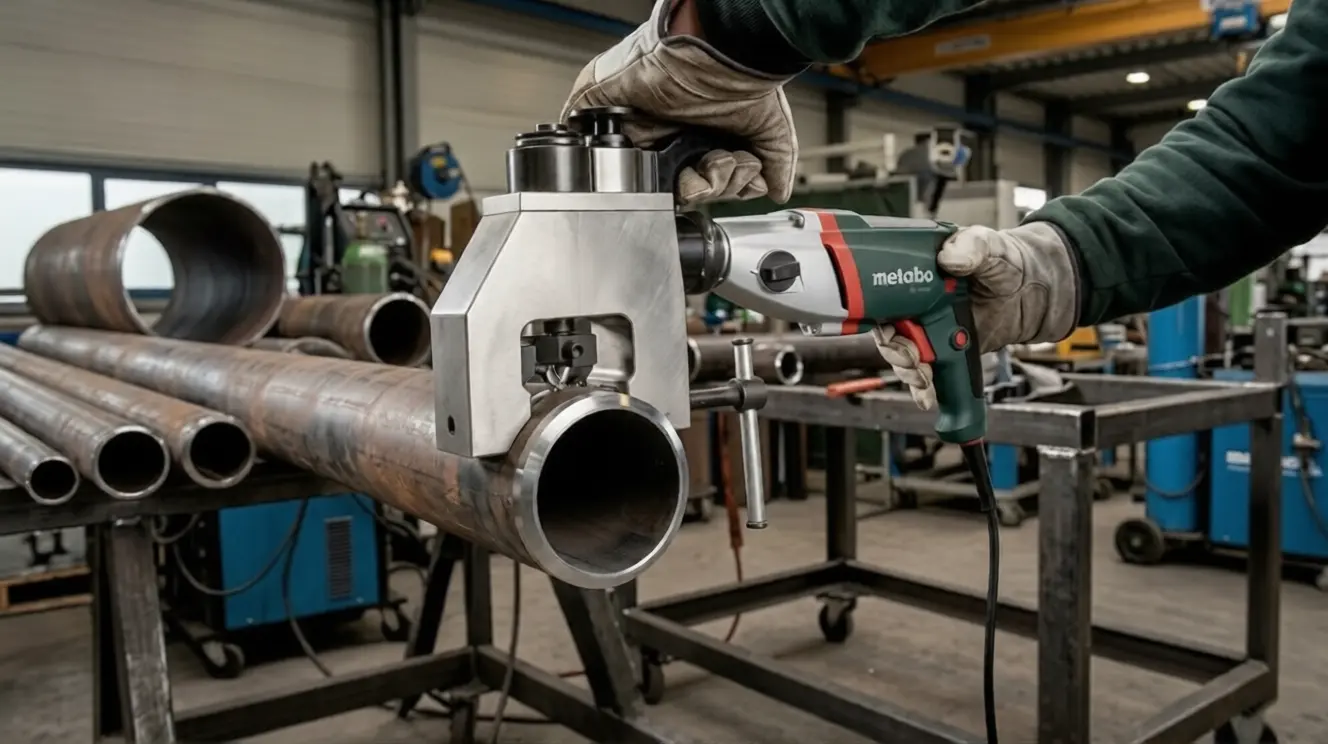 ISC Block Type on a waterwall tube. Notice the compact profile—this is what “fits between adjacent tubes” actually looks like.
The Fit-Up Gap Nobody Talks About
Here’s something I rarely see discussed in beveling guides, but it’s the number one cause of weld defects on boiler tube work: inconsistent root gap due to inconsistent bevel geometry.
When you hand-grind 200 tube ends, every bevel is slightly different. The root face varies from 0.8mm to 2.5mm. The bevel angle varies from 30° to 45°. The fit-up crew has to compensate for every single variation.
On a waterwall panel replacement, this creates a cascade:
- Inconsistent root face → varying root gaps at fit-up
- Varying root gaps → welders adjust parameters tube by tube
- Tube-by-tube adjustments → inconsistent root passes
- Inconsistent root passes → higher rejection rates at RT/UT
A mechanical beveling machine produces the same bevel angle and root face on tube 1 and tube 200. That consistency doesn’t show up as a line item on the equipment quote, but it shows up dramatically in the weld rejection rate.
One contractor I work with tracked their RT rejection rate before and after switching from grinders to ISC Block Types on waterwall work: 11.2% rejection rate dropped to 2.8%. On a 200-tube panel, that’s 17 fewer rejected welds—each one representing 45–60 minutes of grinding, re-welding, and re-testing.
Code Requirements for Boiler Tube Welds
Boiler tube welds fall under ASME Section I (Power Boilers) and ASME B31.1 (Power Piping). The bevel requirements aren’t optional—they’re tied directly to the Welding Procedure Specification (WPS), which references the applicable code.
What the codes actually require
| Parameter | Typical requirement | Your machine must deliver |
|---|---|---|
| Bevel angle | Per WPS (commonly 37.5°) | ±2.5° or better |
| Root face | 1.6mm ±0.8mm typical | Consistent within tolerance |
| Root gap | Per WPS (1.6mm typical for SMAW) | Enabled by consistent bevel prep |
| Surface finish | Smooth, free of notches and slag | Mechanical cutting inherently achieves this |
| HAZ | No hardness increase above base metal | Cold cutting required for alloy tubes |
For specific bevel angle requirements by code and application, I’ve put together a separate detailed reference.
The T91 special case
T91 (and T92) get their own paragraph because the consequences of getting it wrong are severe. These advanced ferritic steels:
- Must be cold-cut. Any thermal cutting process creates a hardened HAZ that requires removal before welding. On a 38mm tube with 6mm walls, grinding back the HAZ can remove enough material to compromise wall thickness.
- Require controlled preheat for welding (typically 200–250°C). Your bevel prep machine operates at ambient—but make sure your cutting process isn’t inadvertently creating a thermal cycle.
- Require PWHT. This is happening regardless of how you cut, but an unplanned PWHT cycle due to thermal cutting damage is schedule-breaking.
Field Setup That Actually Works
After watching crews set up for boiler tube work successfully (and unsuccessfully), here’s what the good crews do differently:
Before the outage
- Get tube specs early. Material, OD, wall thickness, and the WPS. This determines your machine model and insert grade.
- Order inserts for the right material. Standard carbide for SA-210, coated inserts for T22/T91. Order 2x what you think you’ll need—you will use them.
- Do a test run. Bevel 5 tubes on a scrap section. Verify angle, root face, and surface finish meet the WPS. Adjust before you’re on the outage clock.
During the outage
- Set up a prep station. Dedicate one area with good lighting, a bench vise, and your beveling machine. Bring tubes to the station when possible—it’s faster than carrying the machine to every tube location.
- Inspect every 20th bevel. Use a bevel gauge and root face gauge. If the root face is drifting, check your insert for wear. Catching a worn insert early prevents a batch of out-of-spec bevels.
- Maintain your machine daily. During a heavy outage, your machine is running all day. A 15-minute end-of-day routine—clean chips, check insert seating, lubricate the clamp mechanism—prevents the machine from degrading mid-outage.
The math that convinces project managers
| Item | Angle grinder | ISC Block Type |
|---|---|---|
| Per-bevel time (incl. setup) | 12–15 min | 1.5–2 min |
| 200 bevels | 40–50 hours | 5–7 hours |
| Weld rejection rate (typical) | 8–12% | 2–4% |
| Rework time per rejection | 45 min | 45 min |
| Expected rework (200 welds) | 12–18 hours | 1.5–3 hours |
| Total time impact | 52–68 hours | 6.5–10 hours |
That’s a 5–7x time reduction. On a power plant outage where every day of delay costs $50,000–$200,000 in lost generation, the machine pays for itself on the first job.
The Bottom Line
Boiler tube beveling is repetitive, space-constrained, time-pressured work where consistency matters more than peak performance. The right machine turns it into a process. The wrong machine—or no machine—turns it into a bottleneck.
Here’s my decision framework:
- Waterwall panels (SA-210, high volume): ISC Block Type. Rigid, fast at volume, handles the tight spacing.
- Superheater tubes (tight access, smaller OD): Cam-Type. Lighter, faster clamp, fits tighter spaces.
- Economizer tubes (thin wall, facing only): LPM Pipe Facing. Square face, no over-machining.
- Headers and downcomers (thick wall, large bore): ISE T-Model or ISE II-Model. These are pipe-class machines, not tube-class.
If you’re planning a boiler outage and want to spec the right machines before the clock starts, send me:
- Tube material and grade (SA-210, T22, T91, etc.)
- OD and wall thickness range
- Number of tube ends to prep
- Access conditions (open panel, tight tube bank, overhead)
- Welding process (SMAW, GTAW, orbital)
I’ll recommend the exact models, insert grades, and quantities. And if a $200 grinder is genuinely sufficient for your scope, I’ll tell you that too.
Related reading:
- Cold Cutting vs Thermal Cutting — Why mechanical cutting matters on alloy tubes
- Pipe Bevel Angles & Code Requirements — Angle specs by code, including ASME Section I
- Beveling Machine Maintenance — The routine that keeps your machine running through a 2-week outage
- Power & Energy Beveling Solutions — Our complete approach to power plant pipe and tube work
Based on field data from power plant outages across 12 countries, covering coal-fired, combined-cycle, and nuclear facilities. Insert life data from controlled tests on SA-210, T22, and T91 tube samples at our Shenzhen facility. Rejection rate comparisons from customer-reported data—your results will vary with operator skill and WPS requirements.