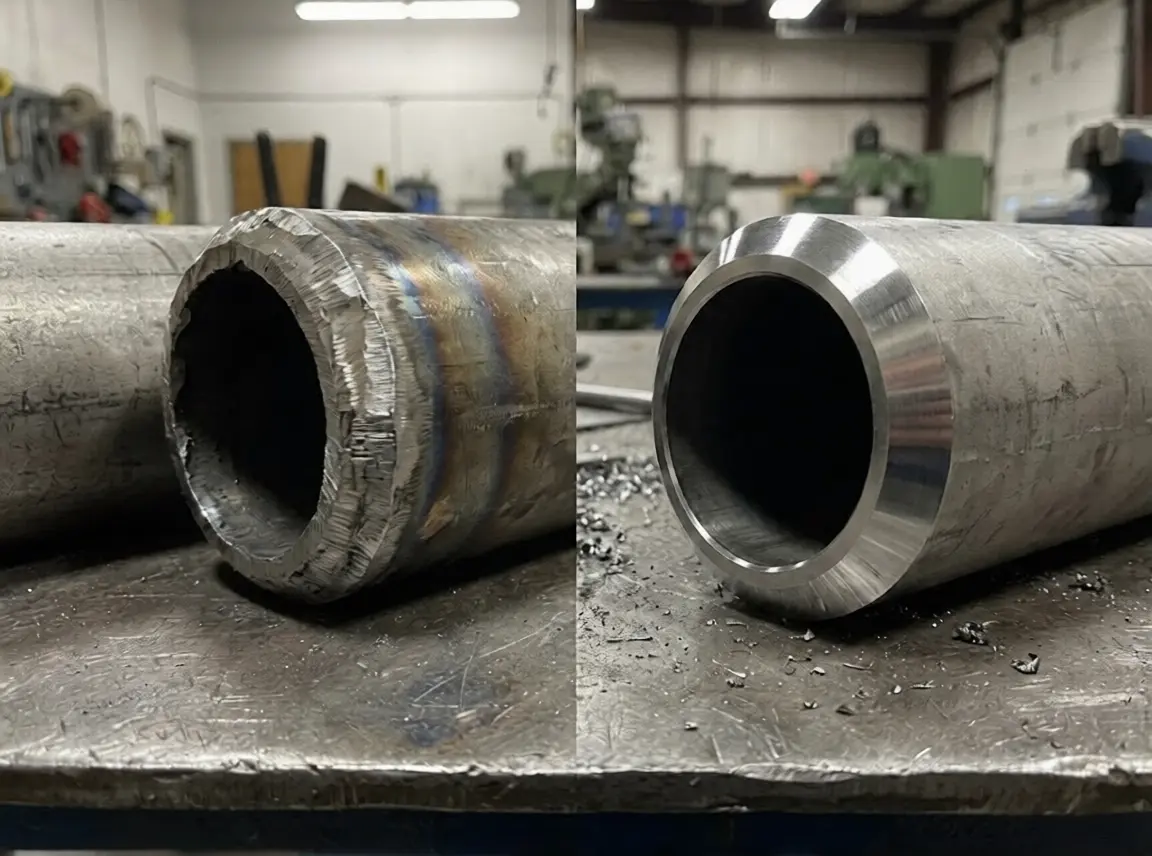
Pipe Beveling in One Sentence
Pipe beveling is the process of cutting an angled surface on the end of a pipe so that two pipes can be welded together with full penetration and structural integrity.
That’s the textbook answer. Here’s the real one: pipe beveling is the single most underestimated step in the entire welding process—and the one responsible for more weld failures than bad welders, bad filler metal, or bad shielding gas combined.
I’ve been manufacturing beveling machines for years, and I can tell you this with absolute certainty: the quality of your weld is decided before the arc is ever struck. It’s decided at the bevel.
Why You Can’t Just Weld Two Flat Ends Together
If you’re new to pipe welding, this is the question that matters most. And the answer is surprisingly simple physics.
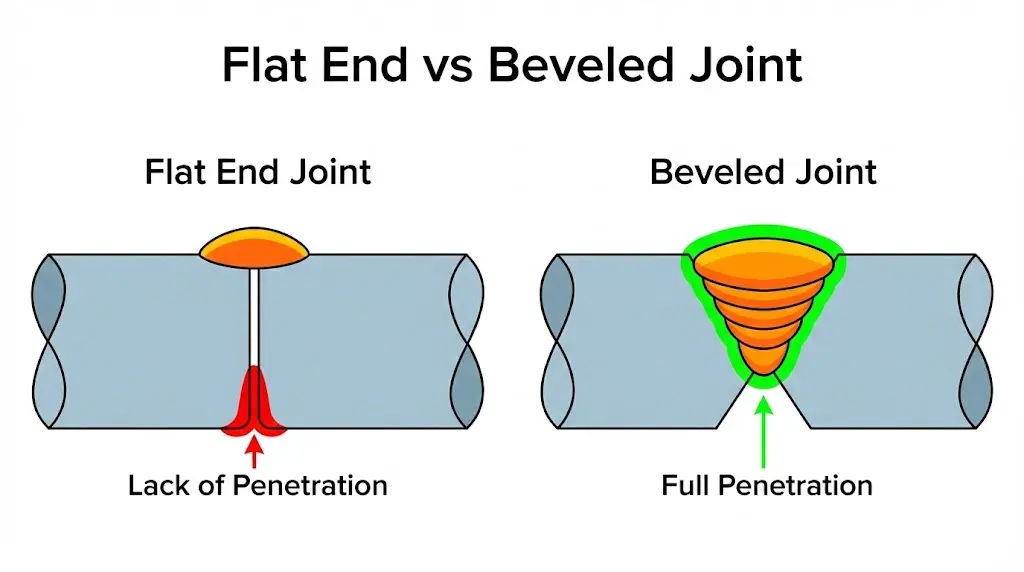
When you butt two flat pipe ends together and try to weld them, the arc can only melt the very surface of the metal. The weld bead sits on top like frosting on a cake—it looks solid, but underneath there’s zero fusion between the two pipe walls.
This is called lack of penetration, and it’s the #1 cause of weld failure in pressure piping systems.
Here’s what actually happens inside a flat-end weld:
- The weld puddle reaches maybe 2-3mm deep on thin wall pipe
- On anything above 6mm wall thickness, the root of the joint gets zero fusion
- The pipe looks welded from the outside, but internally it’s two separate pieces with a cosmetic stripe of metal on top
- Under pressure, the joint fails at a fraction of its rated capacity
Now here’s what a beveled joint gives you:
- The angled surfaces create a groove that the welder fills from root to cap
- The root gap allows the first pass (root pass) to penetrate fully through the wall
- Each subsequent pass fuses to the previous one AND to both pipe walls
- The result is a monolithic joint—metallurgically, it becomes one piece of metal
This isn’t opinion. It’s why every welding code in the world—ASME, AWS, API, EN—requires beveled joints for any pipe above a certain wall thickness. Not recommends. Requires.
The Anatomy of a Pipe Bevel
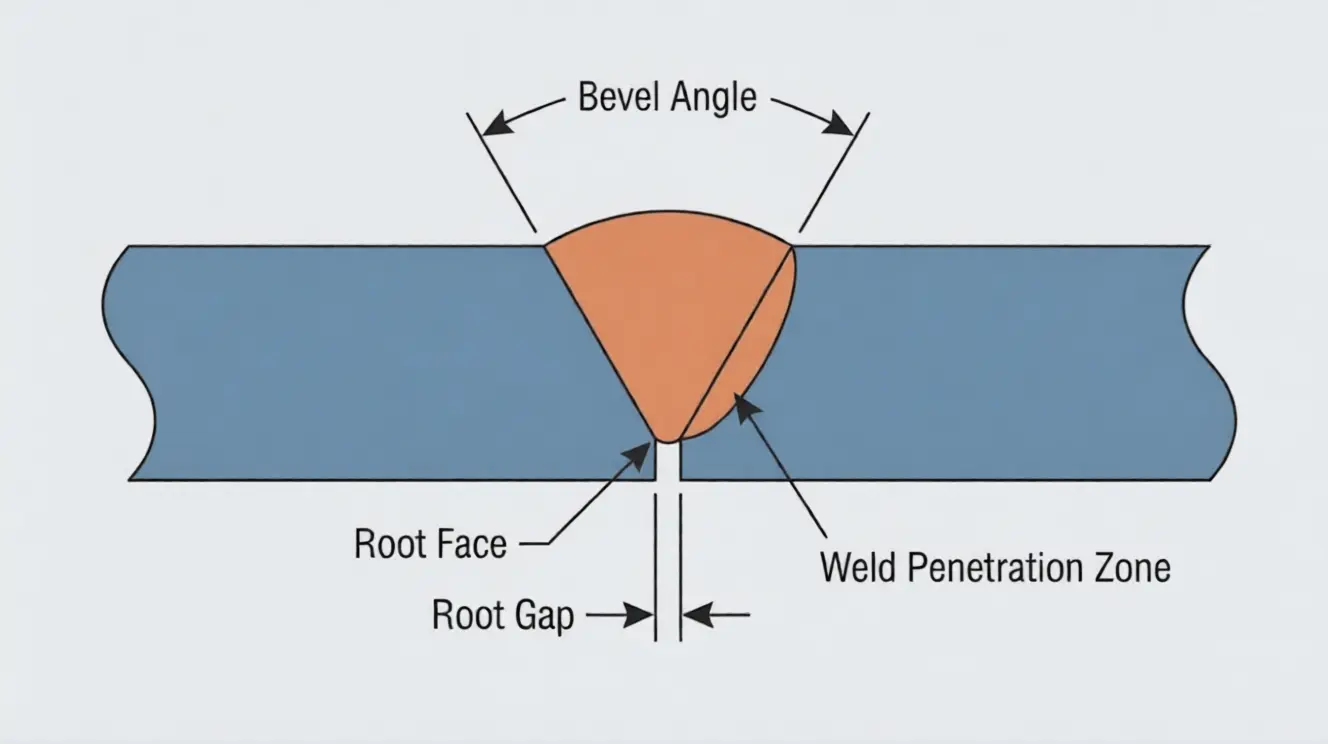
Every pipe bevel has specific geometry that determines how the weld joint will perform. These aren’t arbitrary numbers—each dimension is calculated to balance penetration, filler metal consumption, and joint strength.
Bevel Angle
The angle cut into the pipe end, measured from the vertical axis. Standard V-groove bevel angles range from 30° to 37.5° per side (60° to 75° included angle). The angle determines how much space the welder has to work with:
- Too steep (small angle): The welder can’t reach the root with the electrode. Incomplete fusion.
- Too shallow (large angle): You waste massive amounts of filler metal and welding time. On a 24” pipe, the difference between 30° and 37.5° bevel angle can mean 40% more filler metal.
Root Face (Landing)
The small flat section left at the bottom of the bevel, typically 1-2mm. This is the most critical dimension on the entire bevel:
- Too thick: The root pass can’t penetrate through. You get lack of fusion at the most stressed point of the joint.
- Too thin or zero: The root pass burns through, creating holes and icicles inside the pipe. On process piping, internal protrusions are a code violation.
Root Gap
The space between two prepared pipe ends when aligned for welding, typically 1.5-3mm. This gap allows the root pass to penetrate fully.
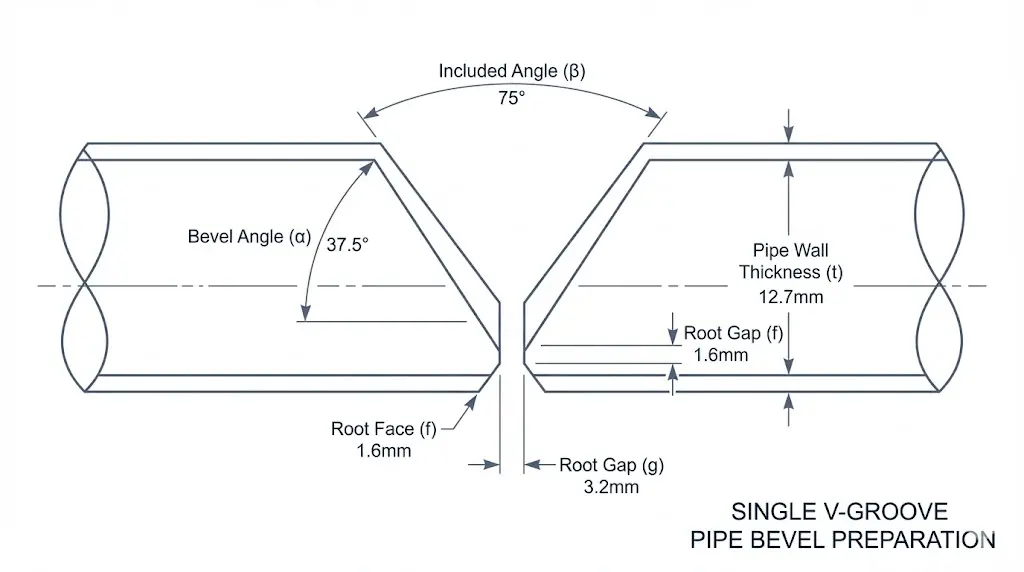
Here’s what I tell every customer: the bevel angle gets all the attention, but the root face is where bevels actually fail. A machine that can hold bevel angle to ±0.5° but lets the root face vary by ±1mm is a machine that will cause you problems. This is why I push customers toward dedicated beveling machines instead of angle grinders—it’s not about the angle, it’s about the root face consistency.
Common Bevel Types and When to Use Each
There’s no “best” bevel type. There’s only the right bevel for your wall thickness, welding code, and process.
V-Bevel (Single V-Groove)
The most common bevel type. Both pipe ends are beveled to create a V-shaped groove.
- When to use: Wall thickness up to ~20mm. Standard for most process piping and structural work.
- Included angle: Typically 60° (30° per side) for SMAW/GTAW, 60-75° depending on the code.
- Advantage: Simple to prepare, weldable from one side.
- Limitation: Above 20mm wall thickness, the amount of filler metal becomes excessive.
J-Bevel (J-Groove)
A curved bevel profile that reduces the groove volume compared to a V-groove.
- When to use: Wall thickness above 20mm, pressure vessel nozzles, any joint where filler metal savings justify the extra machining complexity.
- Advantage: 30-50% less filler metal than V-groove on thick walls. Less distortion.
- Limitation: Requires a beveling machine with J-prep capability. You can’t do this with an angle grinder.
Compound Bevel
Multiple angles on the same bevel face—typically a steeper angle near the root and a shallower angle at the cap.
- When to use: Very thick walls (30mm+), specific code requirements for nuclear or high-pressure applications.
- Advantage: Optimizes both root access and filler volume.
- Limitation: Requires precision machining. Most portable machines can’t do this.
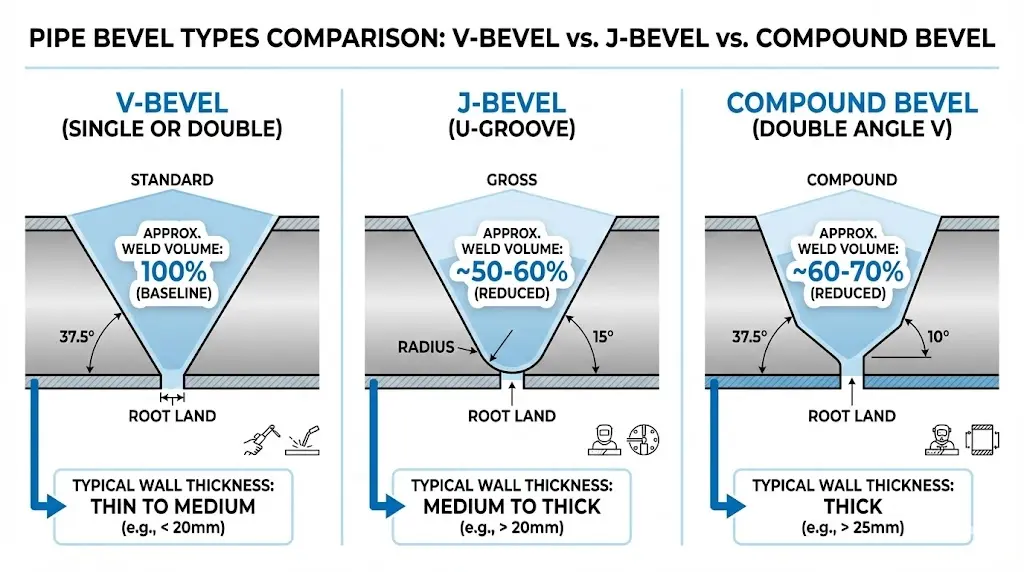
For a deep dive into all bevel types including U-groove, K-groove, and double-V, see our complete guide to pipe bevel types.
What Happens When Beveling Goes Wrong
I’ve seen this enough times to write a book about it. Here are the three beveling failures that cost shops the most money:
1. Inconsistent bevel angle
When the bevel angle varies around the circumference of the pipe—common with angle grinders and poorly maintained machines—the welder has to constantly adjust technique. Some sections get too much filler, others too little. The result: inconsistent root penetration and a weld that looks fine on the surface but fails volumetric inspection (X-ray or UT).
Real cost: A pipeline contractor in the Middle East was getting 18% radiographic reject rates. After investigation, 14 of the 18 rejected joints had bevel angle variations exceeding ±3°. All were prepped with angle grinders. After switching to ISE T-Model beveling machines, reject rates dropped to 2.5%.
2. Root face out of tolerance
This is the silent killer. The root face looks “close enough” by eye, but a variation of 0.5mm can be the difference between a good root pass and a burn-through. On stainless steel or chrome-moly pipe where the root pass is made with GTAW (TIG), this tolerance is critical.
3. Surface finish too rough
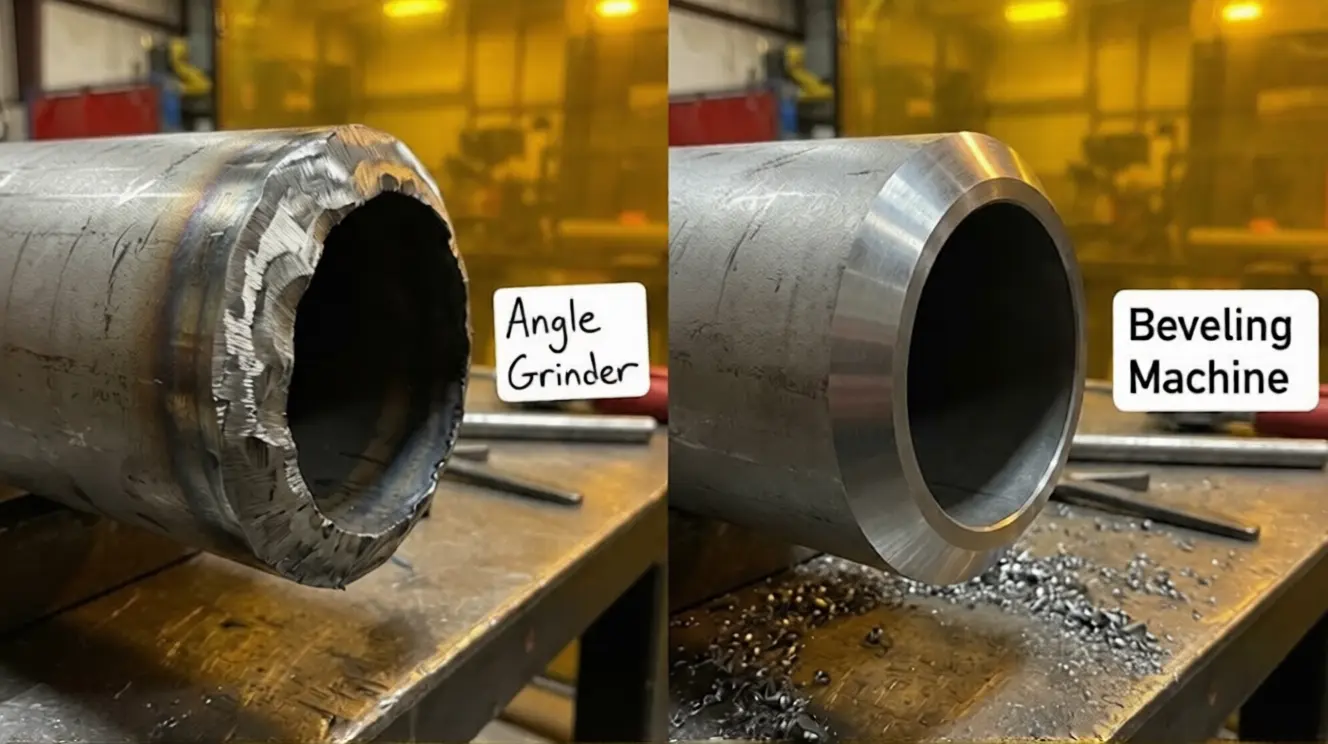
Grinding marks, gouges, and torn metal on the bevel face create micro-notches that become stress concentrators in the weld. On fatigue-sensitive applications (offshore, power generation), rough bevel surfaces contribute to premature cracking.
This is why codes like ASME B31.3 and API 1104 don’t just specify the bevel geometry—they specify the surface finish of the bevel face. A machine-cut bevel meets these requirements automatically. An angle-grinder bevel requires extra effort and inspection to verify.
How Pipe Beveling Is Actually Done
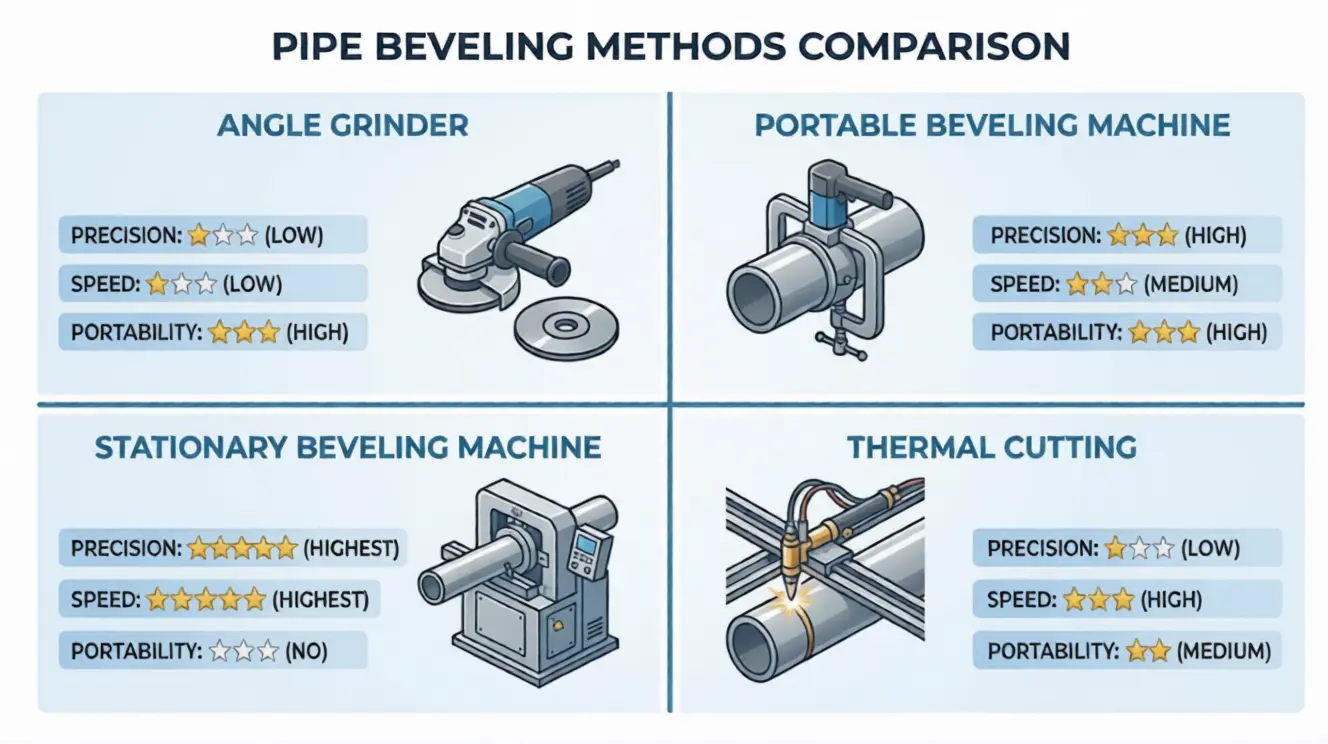
There are four main methods, and I’ll tell you honestly which ones I’d recommend for different situations:
1. Angle Grinder (Manual Grinding)
The cheapest entry point—a $200 grinder with a flap disc or grinding wheel.
Honest assessment: Fine for occasional, non-critical work. Terrible for anything that goes through inspection. Consistency is entirely dependent on the operator, and even the best operator can’t match a machine on a 12” pipe. I’ve written a detailed comparison of angle grinders vs beveling machines if you want the full math.
2. Portable Pipe Beveling Machine (ID or OD Mount)
This is what most professional pipe shops and field crews use. The machine clamps onto the pipe (either inside or outside), and a rotating cutter head machines the bevel with consistent geometry.
- ID-mount machines (like our ISE T-Model and ISC Block Type): Clamp inside the pipe bore. Leave the outside completely accessible. Preferred for most pipe work.
- OD-mount machines (like our Split Frame series): Clamp around the outside. Necessary for installed piping or when the bore isn’t accessible.
Honest assessment: The best balance of portability, precision, and speed for 90% of pipe beveling work.
3. Stationary Beveling Machine
Workshop-based machines like our DCM series that deliver the highest precision and fastest cycle times—but can’t go to the field.
Honest assessment: If your pipe shop does 50+ bevels per shift and the work doesn’t leave the building, a stationary machine pays for itself in weeks. If you need field capability, this isn’t your primary machine.
4. Thermal Methods (Oxy-fuel, Plasma)
Cutting torch with hand grinding to create the bevel shape.
Honest assessment: Fast cutting, but you create a heat-affected zone (HAZ) that often requires grinding removal before welding. For chrome-moly and stainless, thermal cutting creates metallurgical damage that cold cutting avoids entirely. See our cold cutting vs thermal cutting comparison for the engineering details, or read the complete pipe cold cutting machine guide for equipment selection.
The Question Nobody Asks Until It’s Too Late
Here’s what I wish every pipe shop owner, project manager, and procurement engineer would ask before their first weld:
“What is our cost per bevel—including rework, failed inspections, and schedule delays?”
Nobody tracks this number. They track filler metal cost, welder hours, equipment depreciation—but they don’t track the cost of a bad bevel. And in my experience, bad bevels are the single biggest hidden cost in pipe fabrication.
Consider this: a rejected weld on a 10” Schedule 80 pipe means:
- Cutting out the bad weld (~30 minutes)
- Re-prepping both pipe ends (~60 minutes with a grinder, ~15 minutes with a machine)
- Re-welding (~90 minutes for a full multi-pass)
- Re-inspecting (~waiting for the inspector, plus the actual test)
That’s 3-4 hours of lost productivity per rejected joint. At a burdened labor rate of $80-120/hour, each rejection costs $240-$480. On a project with 500 joints and a 15% reject rate attributable to bevel prep, that’s $18,000-$36,000 in hidden costs.
A dedicated beveling machine that eliminates those rejections costs $3,000-$15,000. The math isn’t even close.
For a detailed breakdown of beveling machine costs and ROI, see our beveling machine cost factors guide.
The Bottom Line
Pipe beveling isn’t complicated. It’s cutting an angle on the end of a pipe so that a welder can create a full-penetration joint. Every first-year welding student learns this.
What’s not obvious—and what costs the industry millions every year—is that beveling quality directly determines weld quality. The bevel isn’t just preparation for the weld. The bevel IS the foundation of the weld. Get it wrong, and no amount of welding skill can fix it. Get it right, and you make every welder’s job easier, faster, and more likely to pass inspection.
If you’re evaluating your weld prep process and wondering whether it’s time to upgrade from manual methods, here’s what I’d recommend:
→ Explore our full range of beveling machines: Browse All Pipe Beveling Machines
→ Not sure which type you need? Start with our best pipe beveling machines selection guide
→ Ready to get specific? Tell us your pipe diameter and wall thickness, and I’ll recommend the right machine—even if it’s not one of ours.