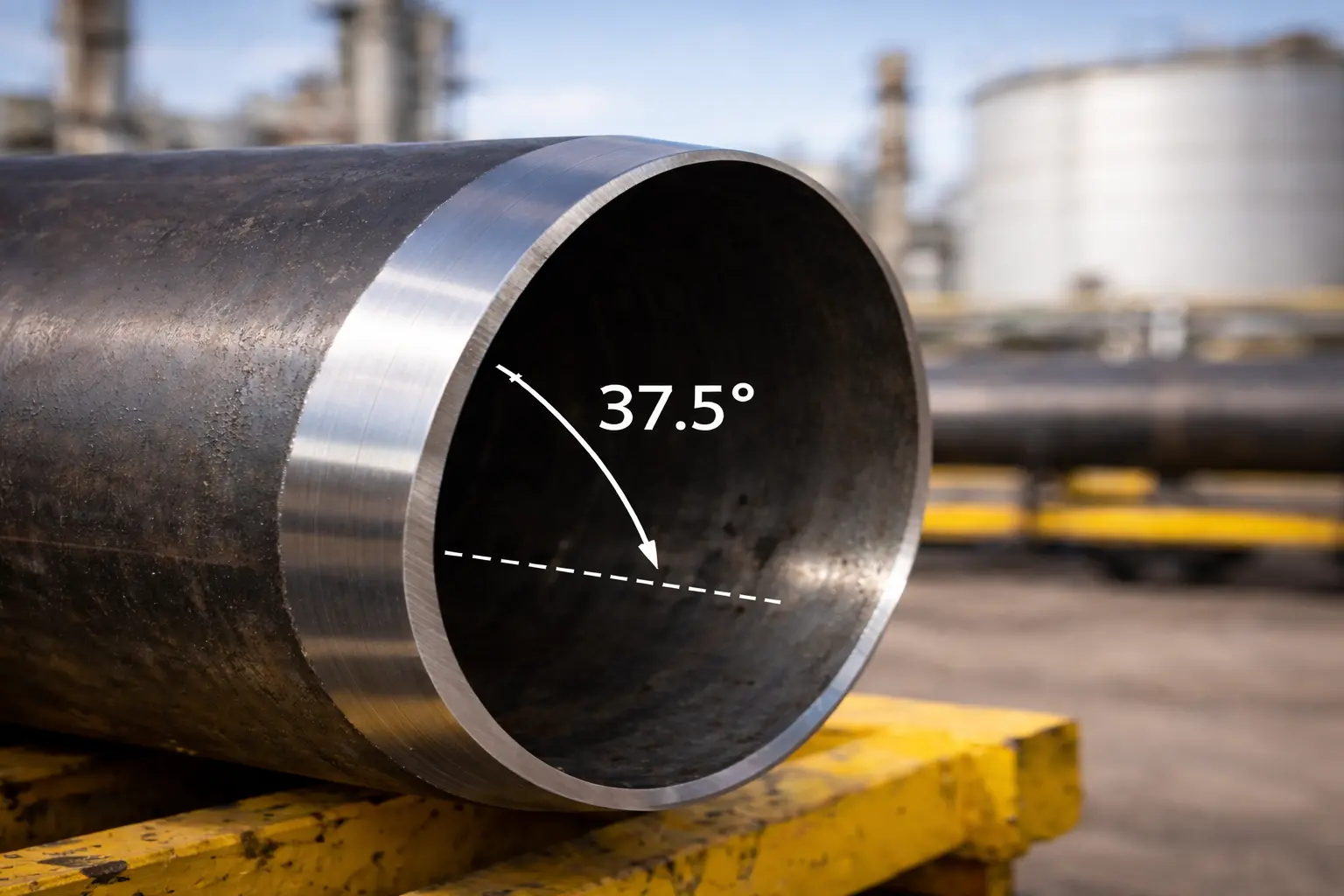
Stop Asking for the “Standard J-Bevel Angle”
At least twice a month, an engineer sends me a drawing request: “Quote a machine that can do a standard J-bevel.”
My first question back is always the same: which J-bevel? Because unlike the 37.5° V-groove everyone memorized in trade school, a J-bevel is not one angle. It’s a dimension set — and if your supplier can’t list all three numbers without looking them up, they’ve never actually machined one.
A J-bevel (J-prep, J-groove — same thing) is a weld end preparation where the pipe wall is machined into a J-shaped cross section:
- a curved root radius at the bottom,
- transitioning into a nearly vertical side wall,
- sitting on a small flat root face (land).
The point of the shape is brutally simple: on heavy-wall pipe, it keeps the groove walls almost parallel instead of opening up into a huge V. Less open volume = less filler metal = fewer passes = less time your welder spends filling a hole you created.
If you want the full landscape of bevel profiles first, my 7 pipe bevel types comparison covers V, compound, U and counterbore side by side. This article goes deep on J only — because the search data tells me that’s where the confusion is.
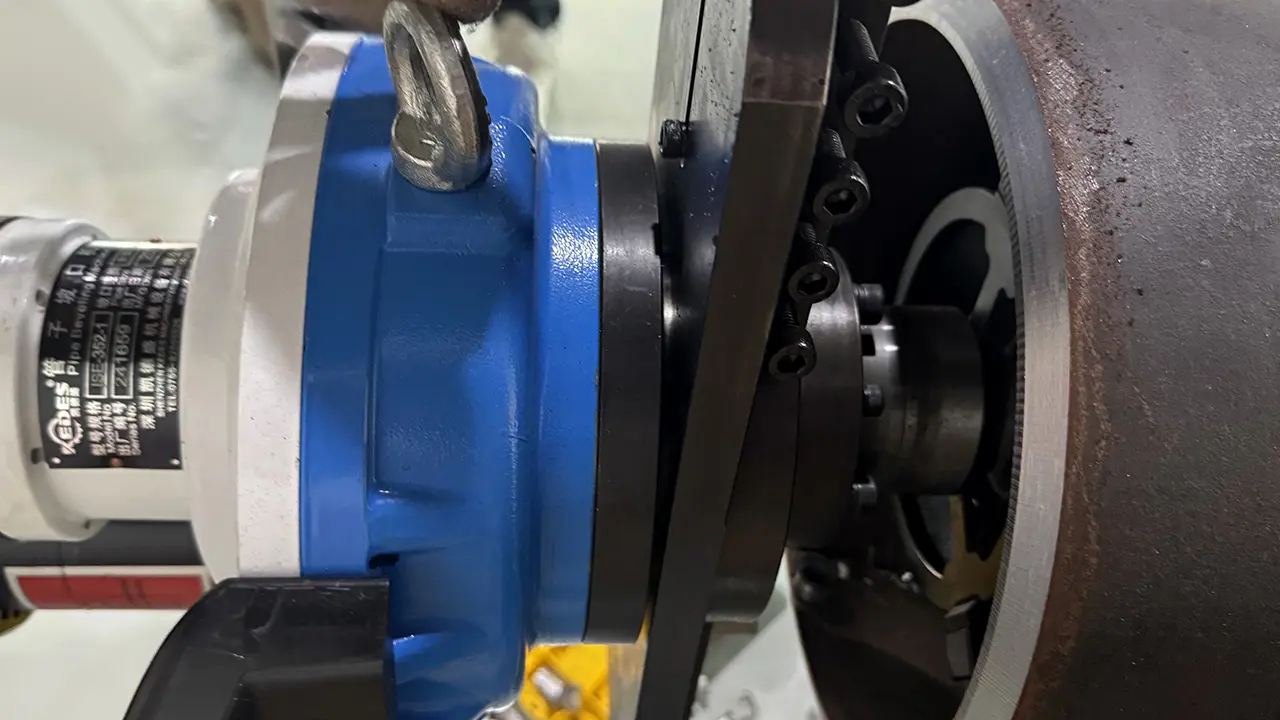
For heavy-wall J-prep work you also need equipment that can hold a form tool rigidly enough — that’s exactly what our ID-mount pipe beveling machine lineup is built for. More on machining later.
J-Bevel Dimensions & Angles (The Numbers Everyone Searches For)
Here is the dimension set that actually defines a J-bevel. These are the typical industry ranges — your WPS overrides everything:
| Dimension | Typical Range | Notes |
|---|---|---|
| Groove (side wall) angle | 10–20° per side | Manual GTAW/SMAW root. Mechanized narrow-groove GTAW: 2–8° |
| Root radius | 4.8–6.4 mm (3/16–1/4 in) | The curve a torch can never cut. Smaller radius = less volume but harder root access |
| Root face (land) | 1.6 mm ± 0.8 mm (1/16 in) | Same role as on a V-bevel — controls burn-through |
| Root gap (fit-up) | 0–3.2 mm | Tighter than V-groove; J-prep is less forgiving of sloppy fit-up |
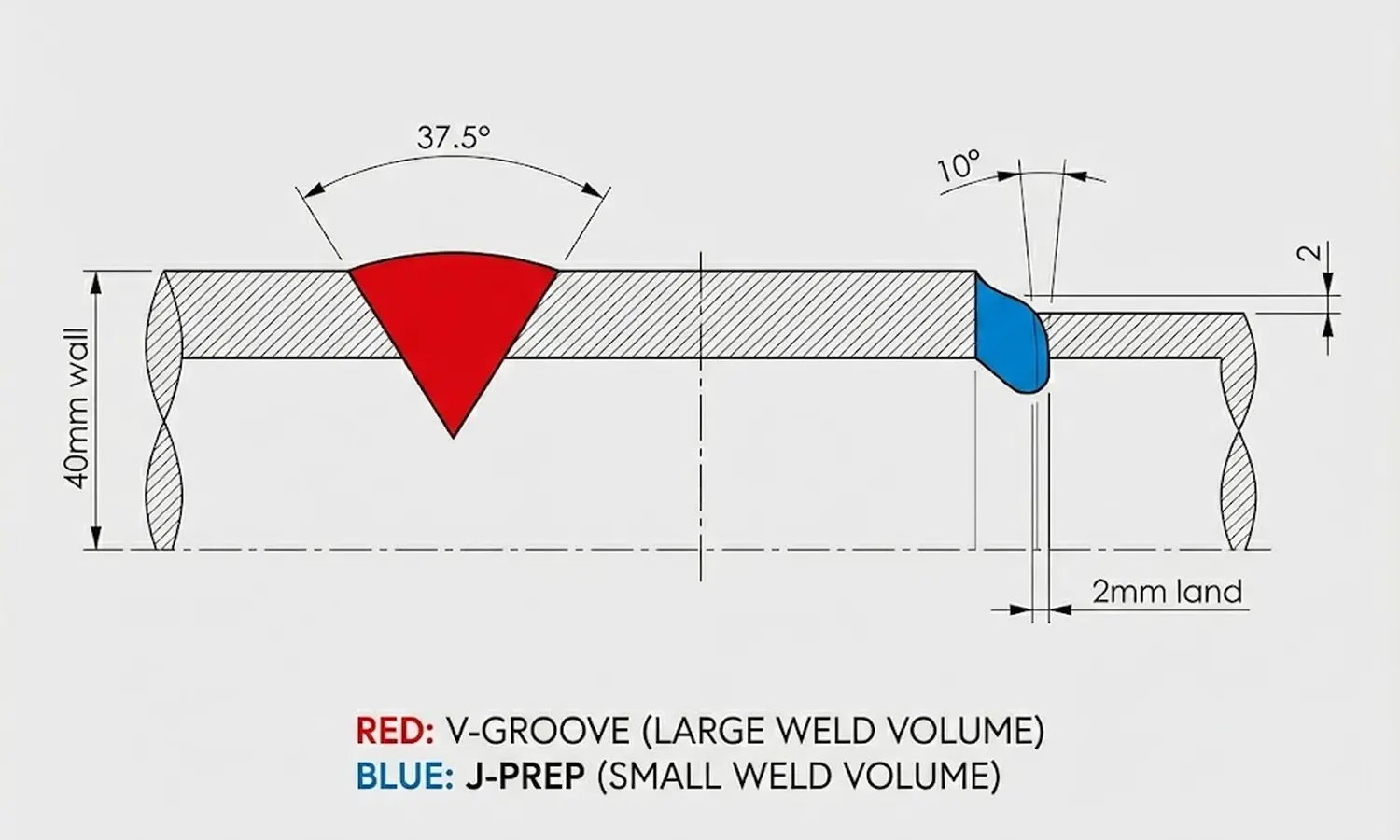 Same wall thickness, two preparations: the V-groove (left) opens up exponentially; the J-prep (right) stays near-parallel
Three things I tell every customer about these numbers:
- The radius is the defining feature. A “J-bevel” with no root radius is just a steep V. The radius is what gives the welder room to manipulate the root pass inside a narrow groove.
- The smaller the side angle, the more you save — and the more your process must be controlled. A 5° groove welded with sloppy manual SMAW is a lack-of-fusion factory. Match the angle to your welding process, not to the savings spreadsheet.
- Root face rules don’t change. Everything I wrote about land dimensions in the pipe bevel angles code reference applies here unchanged.
J-Bevel vs V-Groove: It’s a Volume Argument, Not a Style Argument
The math is unforgiving. Weld cross-section area on a V-groove grows roughly with the square of wall thickness. On a J-prep it grows almost linearly, because the walls stay near-parallel.
| Wall Thickness | 37.5° V-Groove | J-Prep (15°, R6.4) | Filler Metal Saved |
|---|---|---|---|
| 15 mm | Baseline | Not worth the tooling | — |
| 25 mm | 100% | ~65% | ~35% |
| 40 mm | 100% | ~55% | ~45% |
| 60 mm+ | 100% | ~50% | ~50% |
And filler metal is the cheap part. The real money is arc time: every kilogram of weld metal you don’t deposit is welder hours, interpass heating cycles, and NDE risk you don’t pay for. On alloy work — P91, duplex, Inconel — where consumables run 10–30× carbon steel prices, the case stops being arguable at all. (P91 has its own set of traps; see my P91 beveling guide.)
My position: above 25 mm wall, defaulting to a 37.5° V-groove is not “conservative.” It’s expensive habit wearing a safety costume.
When J-Bevel Pays Off
The switch is justified when you can answer yes to two of these three:
- Wall thickness > 22–25 mm (Schedule 160 / XXS territory). This is the threshold where V-groove volume starts to hurt.
- Repeating joint count. One field repair weld? Keep the V. Two hundred shop welds on a vessel nozzle run? The J-prep tooling amortizes in the first week.
- Expensive filler or expensive welder-hours. Alloy consumables or unionized site labor both tilt the math hard toward J.
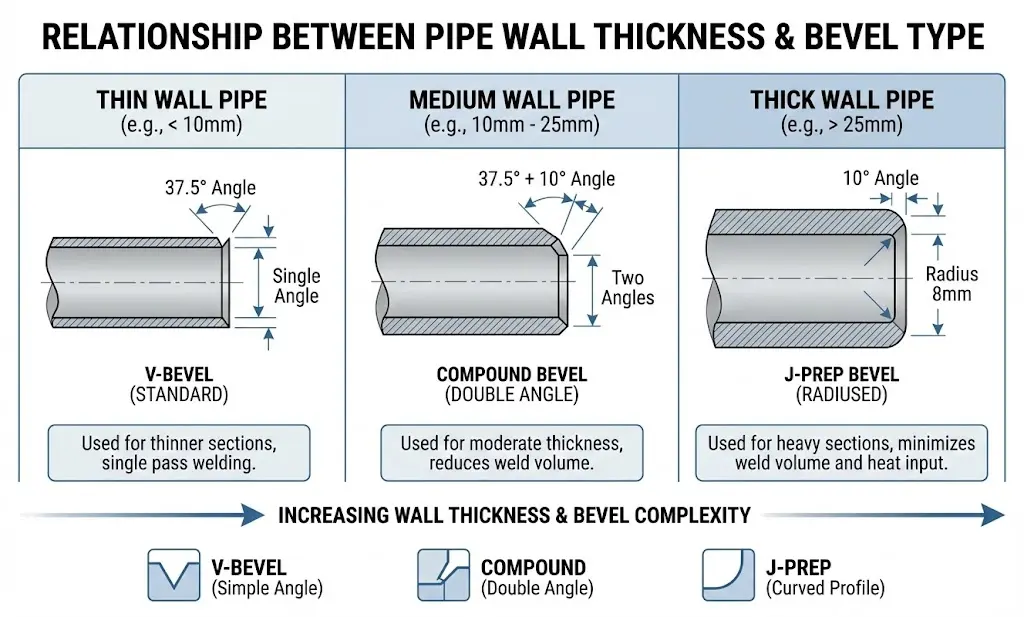 Wall thickness is the first and most reliable selector for bevel type
When NOT to Use a J-Bevel
I sell the machines that cut these, so believe me when I say: J-prep is wrong for a lot of jobs.
- Thin wall (< 20 mm). The volume savings are negligible and you’ve added tooling cost, WPS qualification cost, and fit-up sensitivity for nothing.
- No machining access. A J-bevel cannot be flame-cut or ground freehand. If your site workflow is torch-and-grinder, a J-bevel drawing is a fantasy.
- Sloppy fit-up environments. Narrow grooves amplify Hi-Lo and root gap errors. If your pipe ends arrive oval and mismatched, fix that first — counterboring before exotic groove geometry.
- Unqualified WPS. Your existing 37.5° V procedure does not cover a J-groove. Budget the qualification weld and the PQR paperwork, or stay with V.
This is the honest boundary: J-bevel is a production optimization, not a quality upgrade. A properly welded V-groove is just as sound — it just costs more to fill.
How to Cut a J-Bevel (Machining Is the Only Way)
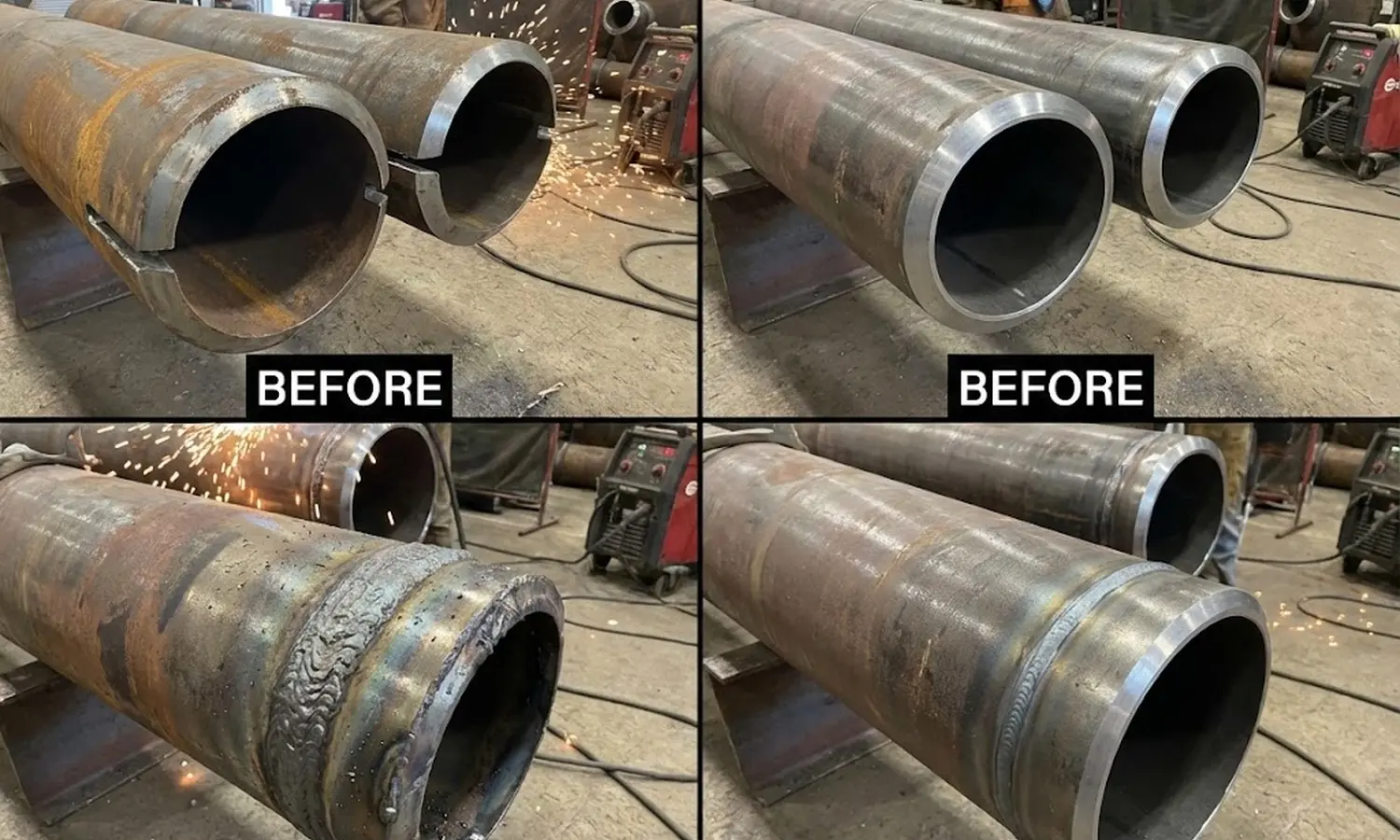
That root radius is the gatekeeper. A torch cuts straight lines. A grinder in human hands produces “approximately J-ish” shapes with ±2 mm repeatability on a good day. Neither passes a fit-up inspection on critical pipework.
Your real options:
- ID-mounted beveling machine with a J-prep form tool. The machine locks inside the bore, and a profiled carbide insert cuts radius + wall angle + root face in a single setup. This is the standard approach for field and shop work on 2”–24” pipe — our ISE-II internal expansion series runs J-prep tooling as a stock option.
- OD-mounted / split frame machine. For large diameter or in-line cuts where the bore is obstructed. Form tool does the same job from outside.
- Lathe / machining center. Best repeatability for shop spools, useless in the field.
If you’re unsure whether ID or OD mounting fits your job, I broke down the decision in ID vs OD mount pipe bevelers.
One warning from our own test bench: J-prep form tools demand more rigidity than a standard 37.5° insert, because the full profile is engaged at once. An underpowered machine that bevels 37.5° all day will chatter on a J-profile in 40 mm wall. Ask your machine supplier for a J-prep cutting video at your wall thickness before you buy — from us or from anyone.
Code Acceptance: Yes, J-Bevels Are Code-Legal
A myth I keep running into: “our code requires 37.5°.” No major code requires it — they show it as the default example and allow alternatives:
| Code | J-Bevel Status |
|---|---|
| ASME B16.25 | Covers weld end preparations; alternative profiles (compound, J) explicitly recognized for heavy wall |
| ASME B31.3 / B31.1 | Joint geometry is whatever your qualified WPS says. J-groove qualifies like any other groove |
| AWS D1.1 | J-groove joints are prequalified joint details (TC-U4a etc. family) within dimensional limits |
| API 1104 | Joint design qualified through the welding procedure — no fixed bevel mandate |
The full standards landscape, including where each code’s numbers actually come from, is in my welding bevel standards overview and the bevel angles by code reference.
Real Case: 40 mm Wall, 30% Total Joint Cost Reduction
A pressure vessel fabricator came to us welding 40 mm wall nozzles with a 37.5° V — roughly 18 passes per joint with SAW + SMAW root. We requoted the same joint as a 15° J-prep with R6.4 root radius:
 The same 40 mm nozzle joint: 18-pass V-groove vs 11-pass J-prep
- Filler metal: −44%
- Passes: 18 → 11
- Arc time per joint: −39%
- Failed RT rate: unchanged (both passed — geometry doesn’t fix bad welders, see “quality upgrade” myth above)
The J-prep tooling and WPS qualification cost was recovered inside the first 30 joints. They had 400 on the contract.
Where to Go From Here
→ Heavy wall and ready to switch? Browse our pipe beveling machine lineup — every ID-mount series runs J-prep form tooling.
→ Not sure about your dimension set? Send me your wall thickness, material and welding process — I’ll reply with the J-prep geometry we’d recommend and whether it’s even worth it for your joint count. Contact us here.
→ Keep reading: 7 Pipe Bevel Types Compared · Pipe Bevel Angles by Code · ID vs OD Mount Bevelers