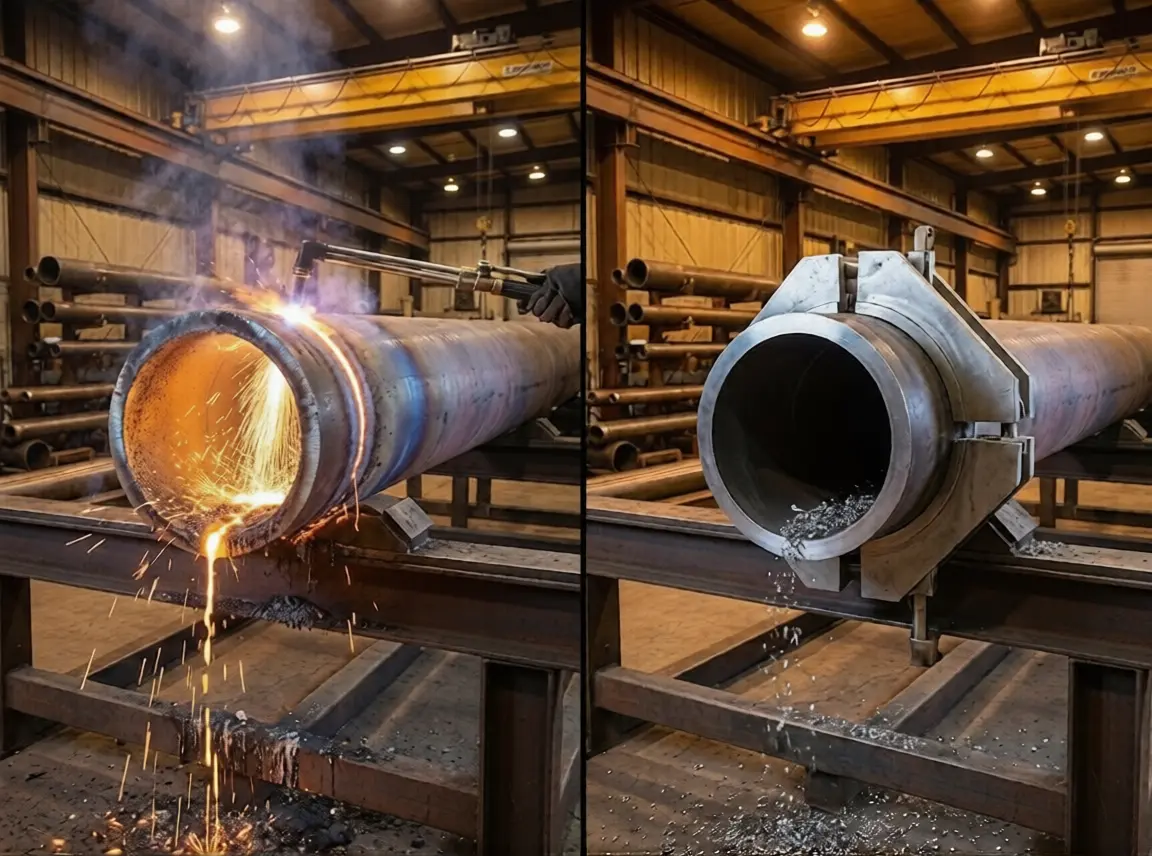
The $180,000 Pinhole Leak
A chemical plant in southern China ran 316L process piping for a caustic washdown system. The fabricator cut the pipe with plasma, ground the bevel faces by eye, and welded them with a properly purged root pass. Every weld passed X-ray. Every weld passed hydro.
Eighteen months later they had pinhole leaks — not at the welds, not in the base metal, but in a narrow ring 2–3mm back from every weld on the upstream side of fluid flow. Metallurgical analysis came back the same for every sample: intergranular corrosion along chromium-depleted grain boundaries, textbook sensitization from the plasma cut. The entire downstream run had to be replaced. Estimated cost: $180,000 in material, labor, and two weeks of lost production.
I’ve seen this pattern three times in my career. It is always preventable. And it is always caused by the same misunderstanding: treating stainless steel like it’s just “carbon steel but shinier.” It isn’t. Stainless is defined by a single thin chromium-oxide layer, and every cutting method that adds heat or iron to the pipe attacks exactly that layer.
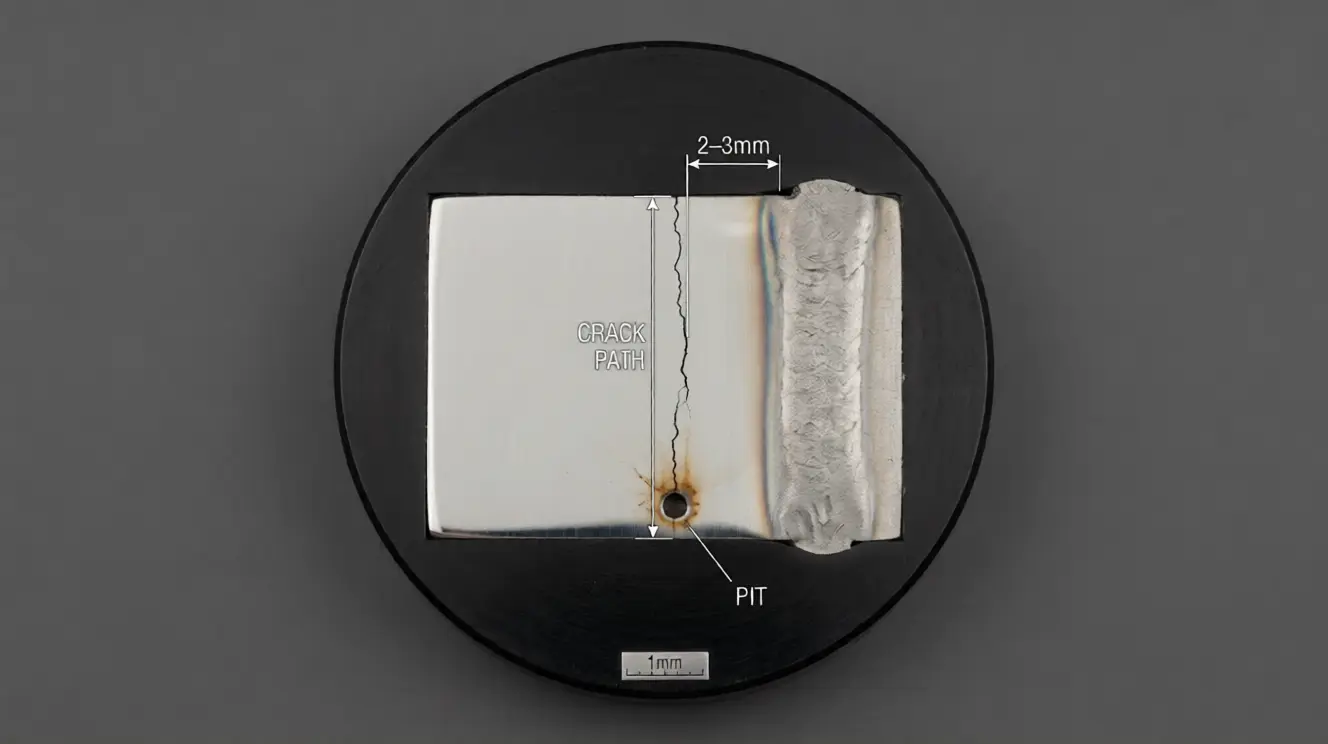 Cross-section of a failed 316L process pipe 18 months after commissioning. The pinhole leaks followed grain boundaries in a ring 2–3mm back from the weld — the exact depth of the plasma-cut sensitization zone.
What Sensitization Does to Stainless
Austenitic stainless steels — 304, 316, 316L, 321, and the duplex grades — get their corrosion resistance from chromium dissolved evenly throughout the austenite matrix. When the steel stays below ~450°C, the chromium stays in solution and the surface self-passivates. The metal is effectively bulletproof against most acids, chlorides, and oxidizers.
Heat it into the 450–850°C window and the metallurgy changes. Chromium atoms migrate to the grain boundaries, where they combine with carbon to form chromium carbides (Cr₂₃C₆). The grain boundary now contains a high-chromium carbide — but the metal immediately around the boundary is depleted of chromium, sometimes to below 12% Cr, which is the minimum needed for stainless behavior.
That depleted ring is where corrosion attacks. The rest of the grain is still stainless. The grain boundary region isn’t. In aggressive service — chlorides, acids, hot caustic — the boundary corrodes preferentially and the metal falls apart along grain lines. This is called intergranular corrosion, and it is the single most common failure mode for stainless piping that was “properly welded” but improperly cut.
Every thermal cutting method parks the cut-face metal squarely in the sensitization window for some period of time:
| Cutting Method | Peak Cut-Face Temp | Time in 450–850°C | Sensitization Depth |
|---|---|---|---|
| Oxy-fuel (w/ powder) | ~2,800°C | 20–60 seconds | 2–5mm (usually unusable) |
| Plasma (air) | ~20,000°C | 3–8 seconds | 0.5–2mm |
| Plasma (N₂ shield) | ~20,000°C | 2–5 seconds | 0.3–1mm |
| Laser (fiber, N₂ assist) | ~10,000°C | 1–2 seconds | 0.2–0.8mm |
| Mechanical cold cutting | < 50°C | 0 seconds | None |
Cold cutting is the only method that never enters the sensitization window. Every thermal method creates a zone that must be removed before welding, or the pipe will fail in service. The question is not “if” — the question is “how deep and how expensive to remove.”
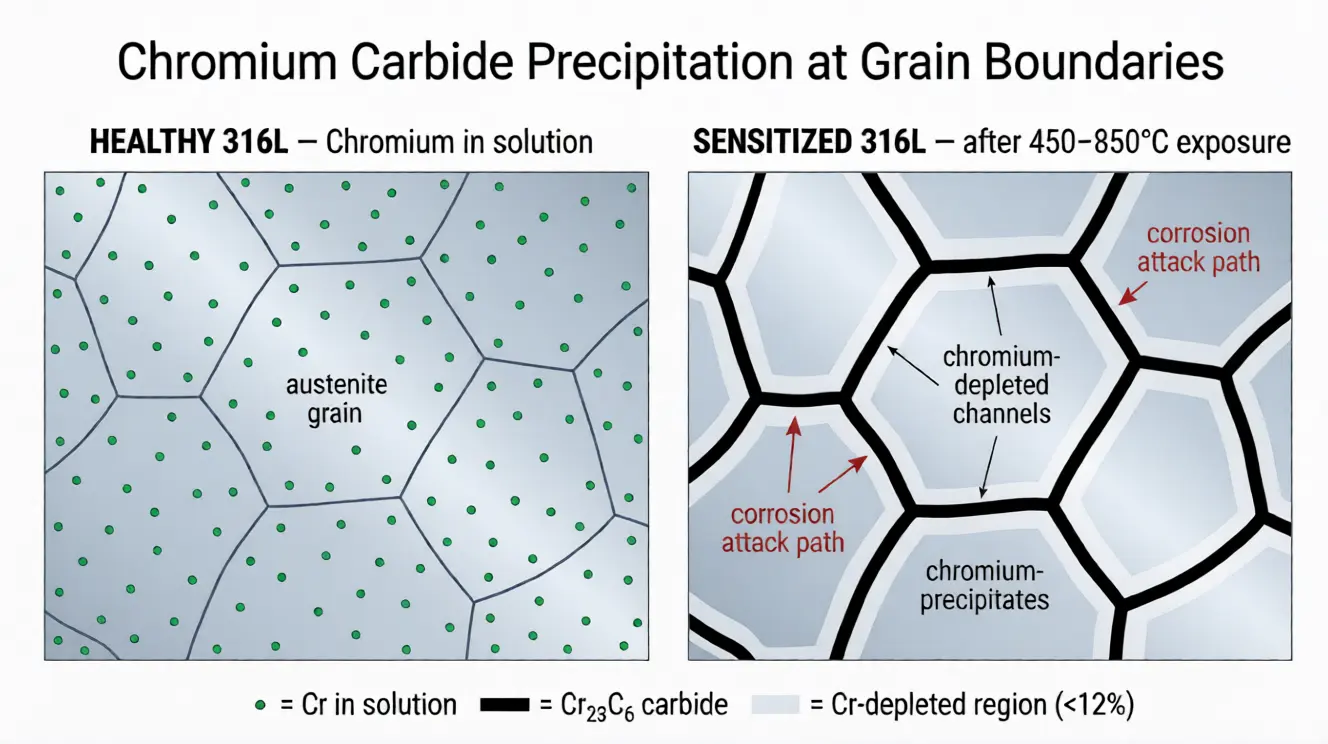 Left: healthy 316L with chromium distributed evenly across the austenite grain. Right: sensitized 316L after thermal exposure to 450–850°C — Cr₂₃C₆ carbides form at grain boundaries and drain chromium from the adjacent metal, creating corrosion-vulnerable “ditches.”
Three Grades That Punish Mistakes
Not every stainless responds to heat the same way. In my experience supplying beveling equipment to fabricators across six continents, the failure modes cluster by grade:
304 / 304L (general austenitic)
304 is forgiving. The “L” (low carbon, ≤0.03%) version barely sensitizes at all in a single thermal cutting pass — there isn’t enough carbon available to precipitate significant carbides. Regular 304 (up to 0.08% C) will sensitize, but in non-aggressive service (food, water, dry air) the depleted zone rarely corrodes fast enough to matter.
Where it fails: Chlorinated environments, hot caustic, marine atmosphere, pharmaceutical CIP lines running hot sodium hydroxide. If your service fluid is anything besides room-temperature water, treat even 304L with the same respect as 316L.
316L (molybdenum-bearing austenitic)
This is where most of my customers live. 316L runs pharmaceutical water-for-injection loops, semiconductor ultra-pure chemical delivery, food-grade process piping, and every offshore platform’s topside chemical system. The molybdenum gives it chloride resistance that 304 doesn’t have.
Where it fails: The same molybdenum that improves chloride resistance also makes sensitization more aggressive when it happens — the depleted boundary zone loses both chromium and molybdenum, and the boundary corrodes faster than it would in 304. The $180K case I opened with? That was 316L. On 316L, I will not tolerate thermal cutting on any weld prep surface. Period.
Duplex / Super Duplex (2205, 2507)
Duplex is the trap. It’s 50% austenite, 50% ferrite, and the entire mechanical and corrosion performance depends on that phase balance staying near 50/50. Heat the metal above ~1050°C and the ferrite fraction shifts. Cool it fast and you trap the wrong ratio. Cool it slow and you precipitate sigma phase, which is brittle and corrosion-prone.
Plasma cuts duplex at 20,000°C and then quenches it with the assist gas. This creates a narrow band where the phase balance is wrecked and sigma phase may have formed. The metal at the cut face is not 2205 anymore — it’s something close to it that looks identical in a visual inspection and fails under load.
For duplex and super-duplex, every major specification (NORSOK M-630, API 938-C, Shell MESC SPE 77/312) requires cold mechanical preparation of the weld bevel. Thermal cutting is either prohibited outright or requires 3–5mm of mechanical removal before welding, which makes the thermal cut pointless.
Failure Risk Matrix: Grade × Service Environment
Use this as a gut-check for prep standards. “Cold-cut only” means mechanical prep is the only safe method; anything else loads your customer with a failure timer.
| Service Environment | 304 | 304L | 316L | 2205 Duplex | 2507 Super Duplex |
|---|---|---|---|---|---|
| Potable / clean water | Low risk — thermal OK | Low risk — thermal OK | Low risk — thermal OK | Overkill for service | Overkill for service |
| Food-grade / dairy | Thermal risky | Cold preferred | Cold-cut only | — | — |
| Pharmaceutical WFI / CIP | Not recommended grade | Cold-cut only | Cold-cut only | — | — |
| Semiconductor UHP chemicals | Not recommended grade | Cold-cut only | Cold-cut only | — | — |
| Seawater / offshore | Fails — wrong grade | Fails — wrong grade | Cold-cut only | Cold-cut only | Cold-cut only |
| Hot caustic (NaOH > 60°C) | Cold-cut only | Cold-cut only | Cold-cut only | Cold-cut only | Cold-cut only |
| Chloride process > 60°C | Fails — wrong grade | Fails — wrong grade | Cold-cut only | Cold-cut only | Cold-cut only |
| Concentrated H₂SO₄ / H₃PO₄ | Fails — wrong grade | Fails — wrong grade | Cold-cut only | Cold-cut only | Cold-cut only |
“Cold-cut only” cells are where I’ve personally seen thermal-cut failures in customer service within 12–36 months. Bold cells are where the cost of failure is high enough that every specification I’ve read prohibits thermal prep on the final bevel face.
Why Angle Grinders Make It Worse
If you’ve read my angle grinder vs. beveling machine piece you know I don’t recommend grinders for any code work. On stainless, the problem is worse than just poor geometry.
Friction heat. A 4½” angle grinder spinning at 11,000 RPM puts the wheel-workpiece interface at 600–800°C routinely — squarely inside the sensitization window. The grinder doesn’t cut cold; it grinds hot. A bevel ground with a standard flap disc has a sensitized layer 0.1–0.3mm deep across the entire face. On 304L it’s mostly harmless. On 316L service lines it’s a failure timer.
Iron contamination. This is the one nobody thinks about. Most flap discs and grinding wheels contain iron oxide abrasive or are manufactured on machinery that also processes carbon steel. Grinding stainless with a contaminated disc drags iron particles into the stainless surface, where they embed mechanically in the soft austenite. Within 48 hours in humid air, those iron particles rust. They form pits. Each pit is a chloride trap and a corrosion initiation site.
I’ve walked into fabrication shops where a “stainless” bevel face shows visible red spots within a day of prep. The customer thinks the stainless is defective. It isn’t. The grinder is. If you must grind stainless for any reason, the disc must be dedicated stainless-only, clearly labeled, and stored separately from the carbon steel consumables. Most shops don’t enforce this rigorously, and the cost shows up in the field.
Cold mechanical cutting with carbide inserts doesn’t have this problem — the insert is tungsten carbide, not iron, and the cutting temperature stays below the point where anything migrates. Provided the machine itself isn’t contaminated with carbon steel chips from a previous job, the cut face is clean and passive the moment it’s made.
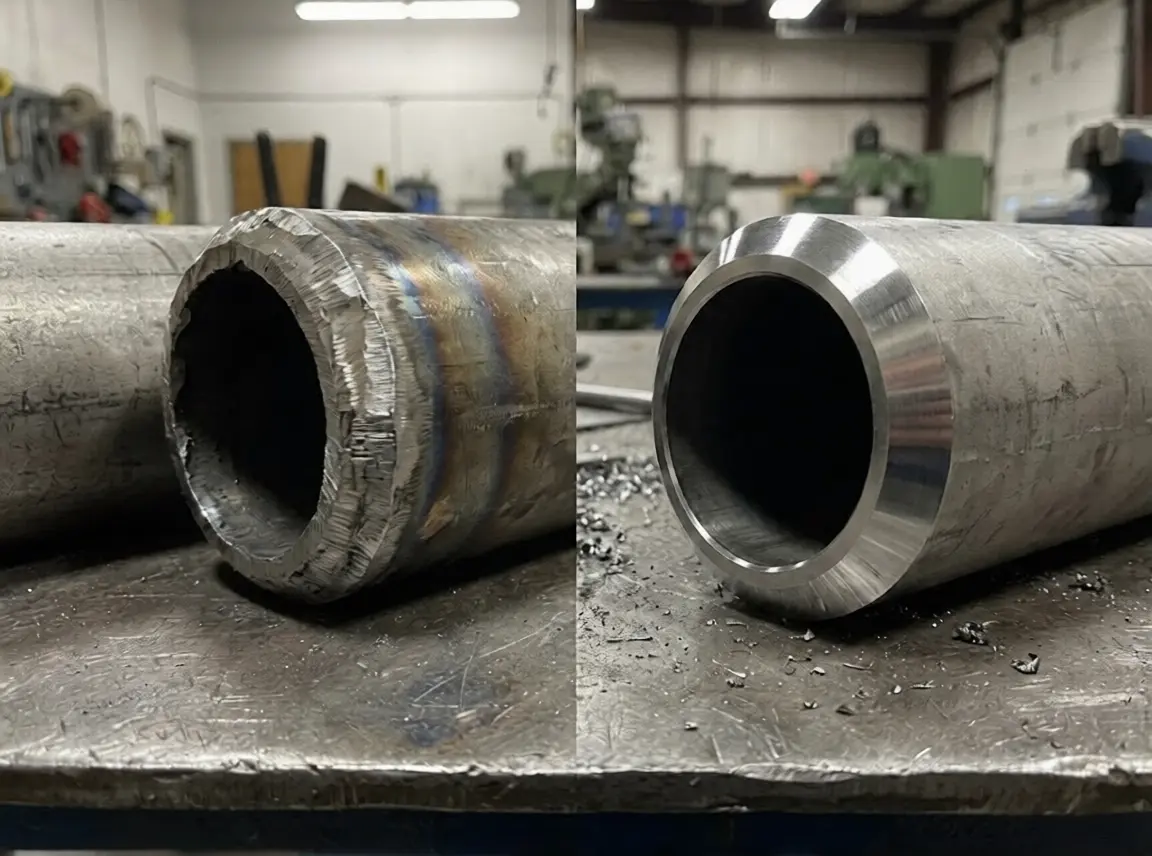
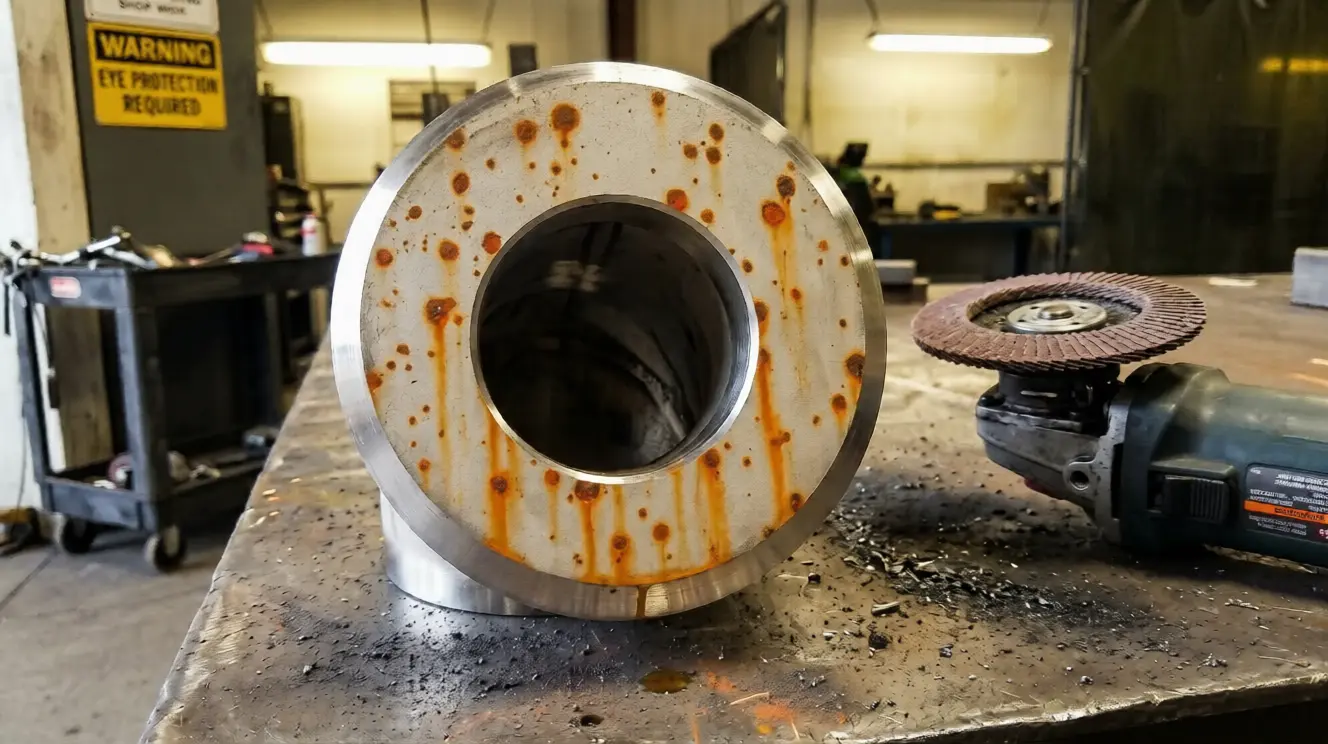 A 316L pipe bevel face 48 hours after grinding with a flap disc previously used on carbon steel. The red spots are embedded iron particles that have already oxidized. Each spot is a future pitting corrosion initiation site — the stainless is not defective; the grinder was.
The Argon Purge Misconception
This is a question I get almost every week from fabricators new to stainless: “We purge the root with argon during welding. Doesn’t that protect against sensitization?”
No. And the misconception is dangerous because it lets people skip the cold-cutting step and pretend they’ve controlled the heat.
An argon purge does exactly one thing: it displaces oxygen and nitrogen on the back side of a weld while the weld is molten, so the root bead doesn’t sugar up with chromium oxide. It is a weld-pool protection mechanism, not a metallurgical repair mechanism. It runs during welding, not before.
The sensitization damage from thermal cutting happens at the moment of cutting, days or weeks before the weld is made. By the time the fit-up is done and the purge hose is connected, the chromium carbides have already precipitated. Purging the weld doesn’t pull them back out.
The only fixes for a sensitized cut face are:
- Solution annealing — heat the entire component to 1050–1150°C and quench, re-dissolving the carbides. Not practical for installed piping.
- Mechanical removal — grind or machine back past the full sensitization depth. On plasma cuts this means removing 1–2mm minimum.
- Not creating the damage in the first place — cold cutting.
Option 3 is always the cheapest. Most of the time it’s also the fastest, once you account for the grinding and re-inspection required by options 1 and 2.
What Cold Cutting Stainless Looks Like
Here’s how my customers in pharma and semiconductor prep stainless pipe. The machine choice depends on pipe size and whether the cut is an in-line modification or a shop fab.
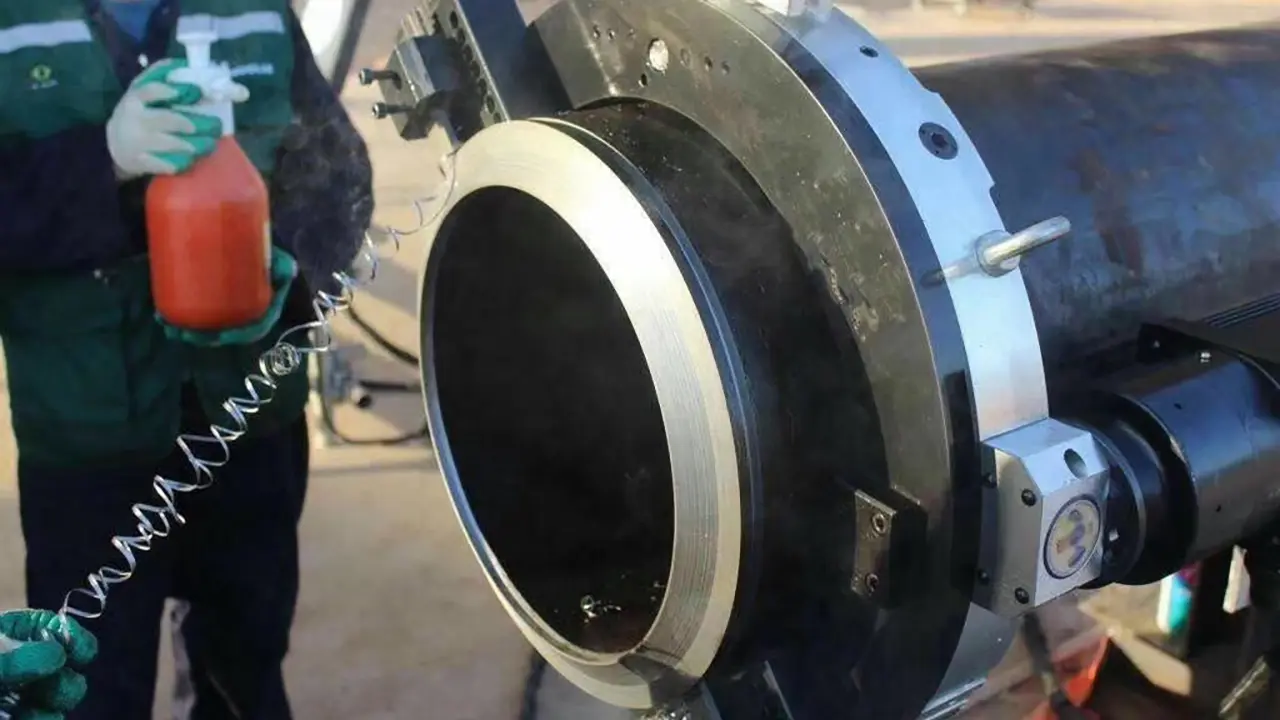
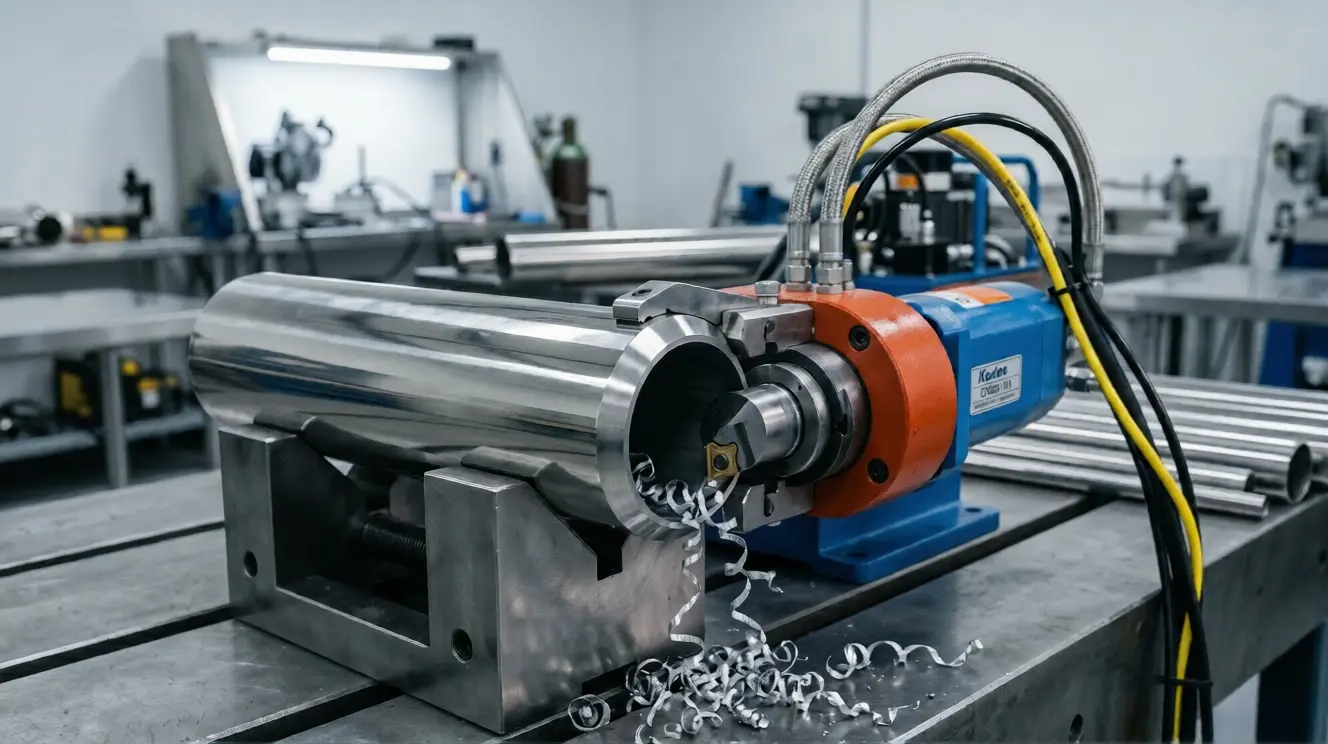 ISE T-Model ID-mount beveling machine preparing a 4” 316L pharmaceutical pipe end. Tungsten carbide inserts, dedicated stainless-only tooling, cutting temperature below 50°C — the bevel face leaves the machine weld-ready with no sensitization, no iron contamination, and no secondary grinding.
Machine Selection for Stainless Steel Pipe Prep
| Pipe Size | Application | Recommended Machine | Cycle Time | Typical Users |
|---|---|---|---|---|
| ≤ 3” (DN80) tubing | UHP gas, orbital welding | SOC Chuck Type | 30–90 sec | Semiconductor fabs, bio labs |
| 1”–12” (DN25–DN300) | Pharma process, food-grade | ISE T-Model | 90 sec–3 min | cGMP fab shops, dairy |
| 6”–24” (DN150–DN600) | In-line cut & bevel | Split Frame | 8–20 min | Chemical, offshore |
| 24”–80” (DN600–DN2000) | Large chemical mains | Planetary Pipe Cutter | 15–45 min | Petrochem, pharma batch |
| Any size, orbital prep | Orbital weld facing | LPM Pipe Facing | 3–10 min | Pharma, semiconductor |
Small-bore shop fabrication (≤ 6” / DN150)
An ID-mount beveling machine like the ISE T-Model centers itself inside the pipe on clamping jaws and machines the bevel from the inside out. Cutting inserts are indexable carbide, dedicated to stainless, and never touch carbon steel. Typical prep time per pipe end: 90 seconds to 3 minutes depending on wall thickness. Surface finish is Ra 3.2μm or better — weld-ready with no secondary grinding.
For tubing under 3” used in ultra-pure chemical delivery, an SOC chuck-type machine handles orbital welding prep with ±0.05mm concentricity, which is what you need for automated orbital welders to make consistent welds.
Medium-bore in-line cuts (6”–24” / DN150–DN600)
A split-frame cold cutter wraps around installed piping and does cut-and-bevel in one operation. The frame is carbide-insert driven, hydraulic or pneumatic feed, and generates no heat worth measuring. For stainless you order it with dedicated inserts and a stainless-grade coolant (water-soluble, chloride-free — do not use standard machining coolants containing chlorides, which cause stress corrosion cracking later).
Large-bore process and pipeline (> 24” / DN600)
Planetary pipe cutting machines handle diameters up to 2m and heavier walls than split frames can manage. Same cold-cutting principle, larger frame, longer cycle time per cut. For pharmaceutical batch reactor piping and semiconductor gas distribution mains, this is the standard.
Facing for orbital welding
When the requirement is a perfectly square end face for orbital welding — standard in pharmaceutical and semiconductor ultra-high-purity lines — an LPM pipe facing machine produces end squareness of ±0.1° and surface finish of Ra 0.8μm. That’s a lathe-quality face on an installed pipe, with zero thermal input.
Total Cost Per Joint: Plasma + Machining vs Cold Cutting on 316L
Timing and cost data from a pharmaceutical piping fabricator tracking both methods on the same spec — 6” Schedule 10S 316L process pipe, 200 joints per month:
| Step | Plasma Cut + Machining | Cold Cutting (ISE T-Model) |
|---|---|---|
| Setup | 3 min | 4 min |
| Cut or cut-and-bevel | 2 min | 3 min |
| Cool & remove dross | 4 min | — |
| Remove sensitized layer (min 1.5mm) | 12 min | — |
| Machine final bevel | 5 min | Included above |
| Clean & passivate cut face | 6 min | 2 min |
| Iron contamination check | 3 min | Not required |
| Rework risk (etch test failures @ ~8%) | +18 min avg | — |
| Total time per joint (avg) | ~32 min | ~9 min |
| Consumables per joint | $6–$10 (plasma + grinding) | $0.80–$1.50 (inserts) |
| Re-do rate (failed Strauss / oxalic test) | 6–10% | < 0.5% |
On 200 joints per month, the cold cutting method saves roughly 75 labor-hours and $1,500 in consumables. Over a year that’s nearly $60,000 in direct savings plus the intangible benefit of dropping re-do rate to near zero — which matters more in cGMP-audited pharma work than the labor savings do.
When Thermal Cutting Is Still Acceptable on Stainless
I sell cold cutting equipment. I’m also going to tell you when you don’t need it, because the moment I stop being honest I lose the argument.
Scrap and demolition. If the pipe is being removed and won’t be welded again, plasma is faster, cheaper, and doesn’t care about sensitization. Use it.
Rough cut before final machining. On very thick wall material where a cold cutter would take an hour per cut, some shops plasma-cut oversize and then mechanically machine the bevel from the rough cut. If you leave 3–5mm of stock past the sensitized layer and machine it away cleanly, the final surface is sound. This is a legitimate technique in pressure vessel shops for heavy-wall stainless — but the final bevel face must be cold-machined, not just ground.
Non-service piping. Handrails, structural supports, cosmetic cladding. Anything that isn’t carrying a corrosive fluid. Heat-related sensitization only matters if the service environment would exploit it. A 316 handrail doesn’t care about chromium depletion at the weld boundary because nothing is trying to corrode it.
Specific 304L non-aggressive water service. Low-temp potable water, clean steam condensate return. 304L with minimal sensitization will give you decades of service in these environments. Don’t over-engineer it.
For anything touching chlorides, acids, caustic, high-purity chemicals, high-temperature service, or code-inspected pressure boundaries: cold cutting. No exceptions.
The Bottom Line
Stainless steel is paying for the chromium in every kilogram. The entire reason your customer chose 316L over A106 carbon is because they want the chromium oxide layer to protect their fluid or their environment or their downstream process from corrosion. Every cutting and prep method that destroys that chromium oxide layer — thermally, mechanically, or through iron contamination — is taking away the thing the customer paid for.
Three rules I give every new stainless fabricator:
- No flame, no arc, no grinder on the final bevel face. Cold mechanical cutting only. If your shop doesn’t own the right machine for the pipe size, sub the prep out. Don’t improvise.
- Dedicate the tooling. Stainless-only inserts, stainless-only machine, stainless-only storage. Iron cross-contamination is invisible until it’s visible, and by then it’s embedded in the customer’s piping.
- The purge doesn’t fix the cut. Whatever welding protocol you’re running — TIG with argon purge, orbital with hydrogen-argon mix, autogenous laser — the welding step cannot undo damage that happened during cutting. Fix the cut first.
If you’re running a shop that does pharmaceutical, semiconductor, food-grade, or offshore stainless fabrication and your current prep process includes plasma, grinders, or shared tooling, your product is accumulating failures that haven’t shown up yet. They’ll show up eventually. The only question is whether they show up in your shop’s warranty claims or in your customer’s process uptime logs.
Tell me what you’re prepping — grade, diameter, wall thickness, service fluid — and I’ll show you the exact machine setup that eliminates the metallurgical risk. Equipment that’s right for 1” pharma tubing is different from what’s right for 24” offshore chemical mains, and getting the match right saves you from the $180K call later.
Related reading:
- Cold Cutting vs Thermal Cutting: Why Your Welding Inspector Will Thank You — The full metallurgical case for cold cutting across all materials
- Pipe Cold Cutting Machines: Types, Selection & Applications — Machine types and selection by pipe size
- Still Using an Angle Grinder for Weld Prep? — Why grinders fail on alloy steels, not just stainless
- Pharmaceutical Piping Solutions — Full stainless prep workflow for cGMP and ASME BPE compliance
- Semiconductor Fab Solutions — Ultra-high-purity gas and chemical delivery piping
Written from field observations at pharmaceutical, semiconductor, and offshore fabrication customers between 2019 and 2026. Metallurgical data cited from independent lab reports on customer samples and published ASTM A262 sensitization tests. I manufacture cold cutting and beveling machines — that’s my bias, and I state it openly. But the chromium chemistry doesn’t care who describes it: heat the metal into the sensitization window and the boundaries deplete. The only thing arguing is the invoice from the rework crew eighteen months later.